
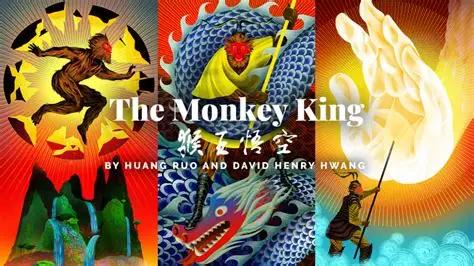
Above: Paulus’ Monkey King (2025) incorporates the best of Chinese literature and artistry with premier opera and Western theatrical, vocal, and transitional techniques (San Francisco Opera).
By Jenny Liang, Associate Reporter at China Insight
On a chilly November afternoon, I entered an inconspicuous old-school brick church in Minneapolis. Like usual, parking was notoriously difficult. After squeezing into a spot, I strained my eyes, looking for an entrance. The screening I was about to attend was an exclusive hidden gem, part of a grassroots initiative by the Chinese Heritage Foundation (CHF) to introduce Minnesotans to Chinese culture.
However, I first had to find my way into the building. All the doors were locked. However, at the main entrance, an attendee spotted us and opened the door. I was finally in!
Today, as part of Chinese Heritage Foundation’s Annual Meeting, there was a special live streaming of the Monkey King Opera by the San Francisco Opera, considered by many as one of the leading opera houses globally. Commissioned in partnership with Minnesota’s own Chinese Heritage Foundation, the opera has successfully brought the most famous Chinese literary classic into life for Americans.
In the late 19th and early 20th century, the United States, spurred by Secretary of State John Hay, proposed an “Open Door Policy” to open the world’s largest nation up to global trade (Office of the Historian). At this point, the vast lands of China were largely unknown to the West. By their entrance, including using military force and coercion, the Chinese were introduced to Western businesses and ideas. Notably, this occurred during the anti-Western Boxer rebellions and the Chinese exclusion act in the States, making such an act of diplomacy ironic.
Today, the political hostility between the two world superpowers continues: In fact, half of surveyed Americans name the People’s Republic of China as the greatest foreign threat, compared to 17% naming the Russian Federation and 2% of respondents claiming the People’s Republic of Korea, or North Korea (Pew Research Center). The undisputed superpower since World War II, the United States has been ranked first in the Global Firepower Rankings for over half a century. However, China has risen to third, with the largest military force in the world and the second largest civilian population (2025 Military Strength Ranking).
Nonetheless, despite official hostility, the Chinese Heritage Foundation is actively seeking to create a bridge through introducing the best of Chinese culture to the Mainstream. Yearly, they host Chinese New Year celebrations with traditional music, dancing along with cultural activities at select events throughout the greater community. This year, after attending the sold-out Monkey King Opera in San Francisco, members of the Chinese Heritage Foundation were struck by the “immense scale of the production, its inventiveness, sheer joy, its over-the-top quality in every aspect, and the roaring enthusiasm of the audience!” (Chinese Heritage Foundation).
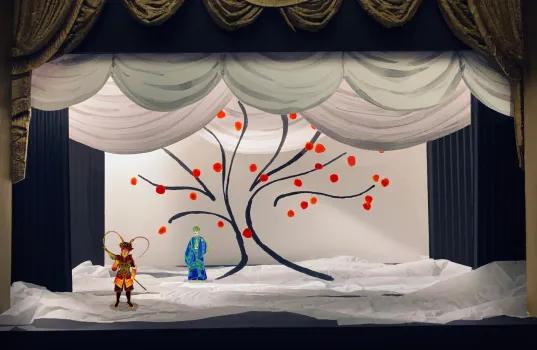
Above: The San Francisco Opera’s The Monkey King (2025) incorporates historic designs and artistic techniques, bringing the legendary Sun Wukong (孫悟空) to life (Santa Cruz Sentinel).
Sun Wukong is the prototype of Chinese literature, and the main character in Wu Cheng’en’s Journey to the West. Starring in the 16th century novel, the rebellious monkey was born from a stone and became the king of the monkeys. Sun Wukong was notoriously mischievous and wreaked havoc in the heavens through his pride and antics. After angering the Buddha, the monkey was imprisoned under a mountain for five hundred years.
With centuries to contemplate his regrets, the Monkey King gained redemption after being freed by the wandering monk, Tang Sanzang (唐三藏), during his pilgrimage to obtain the Buddhist sutras (Sun Wukong). Renewed with a new sense of purpose, the monkey’s powers were refined under Taoist principles in his journey with the Tang Sanzang, his White Dragon Horse, and the swine Zhu Bajie and Sha Heshang (Sun Wukong).
With supernatural strength, Sun Wukong is infamous for being able to lift two mountains while running “with the speed of a meteor,” and traveling 34,000 miles with a single somersault (Sun Wukong). And, as the king of all the monkeys, Sun Wukong “has vast memorization skills and can remember every monkey ever born,” serving his duty to protect his troop (Sun Wukong). And this doesn’t even complete the list.

Above, from left to right: Sun Wukong (孫悟空), Zhu Bajie (猪八戒), the White Dragon Horse (白龍馬), Tang Sanzang (唐三藏), Sha Heshang (沙悟净) (Maling Shaolin Kung Fu Academy).
As I watched the streaming opera, I was immediately struck by the tone: a humorous take on a Chinese classic. The talent of the actors and their singing reflects Western theatre, with a musical backdrop that followed the flow of many productions. The costumes were very dramatic and over-the-top. However, Chinese elements were woven at every turn, including backdrops that reflected traditional artwork, Chinese instruments (like the erhu and pipa), and songs sung in Mandarin in the Chinese opera style.
Even through the barrier of watching through a recording, as well as occasional network crashes, the audience was entranced by the singing and plot. There was a great diversity in the audience, with a roughly equal number of Chinese and American members, children and seniors, and notable representatives in the Minnesota Chinese community. I saw both Chinese and Americans alike spellbound by each twist and turn. From my estimates, there were well over a hundred people crammed in the Church basement. After the bodhisattva’s and Buddha’s songs, they would erupt into applause. They would smile alongside the Monkey’s antics, roaring as he quipped, “this Buddha is so dumb.” When he urinated on the Buddha’s palms, the room exploded, unable to control their laughter.

Above: A snapshot of the audience. There was a diversity of ages, races, and men and women alike.
I realized the effectiveness of delivering awareness about Buddhism through a comedic package. Just as Christianity is viewed by many Mainland Chinese as a “Western” religion, many Americans know nothing about Buddhism besides associating it with smiling Buddha statues and bald monks meditating in orange robes.
With characters like Buddha and the bodhisattva brought to life, elevated above the stage and clothed in elaborate attire, understanding the basics of Buddhist philosophy seemed much less daunting. I saw the importance of humility through anger against the Monkey King’s pride: “Monkey, enough … the time has come for you to stand down.”
And again, we see Sun Wukong’s downfall after being blinded by pride: “Prepare to name me ruler of heaven!” he exclaims, before being trapped under a mountain for five hundred years.
The audience gets a glimpse of Enlightenment, the next stage of understanding characterized by awareness of human existence and suffering. As the Monkey King is hopelessly trapped, the Buddha pleads to him, praying, “open your eyes, let enlightenment shine on you.” We see the dangers of being driven by ego, the snares of self-centeredness, how pride is the ultimate downfall.
Woven throughout the opera, the actors chant, “power alone is not enough.” And as the Buddha said, “you think you serve others, but serve only yourself.”
Who would have known that the story of a mischievous monkey would bring awareness about nirvana, internal striving, and following the advice of the Great sages?

Above: Puppeteer Basil Twist elevated The Monkey King (2025) through a marvelous display of props (Yahoo Entertainment).
As a bonus for those that attended this special screening, attendees were also treated to a live, online discussion by composer Huang Ruo and librettist David Henry Hwang.
This discussion that followed the opera streaming resulted in a lively, informative and entertaining discussion that included questions and answers by Ruo and Hwang from the audience.
The Monkey King opera has received positive reviews across various platforms with its innovative blend of East and West. The opera, transforms the classic 16th-century Chinese tale into a visually stunning and musically rich experience. Critics have praised its vibrant staging, dynamic choreography, and the way it captures the essence of the beloved character, Monkey. The production is noted for its ability to resonate with contemporary audiences while honoring traditional elements, making it a significant addition to the opera repertoire.
Overall, the opera is described as a dazzling triumph that balances youthful mischief with profound wisdom, appealing to both opera enthusiasts and newcomers alike.
As I saw a young American girl donning a bright pink qipao, I realized the power of artistry to bridge between opposing cultures. No language barriers or prejudices stood against pure comedy. Perhaps, the Chinese Heritage Center was engaging in the first waves of a reverse Open Door Policy initiative, where it was the Chinese this time bringing their art, their music, their philosophy and worldviews, their stories, to the Mainstream American culture. The Monkey King is the continuation of this Western introduction to the Chinese classics, opening the door to millennia of Chinese history.
But this time, there was no violence or threat of coercion.
Just a lot of laughter and smiles.
Although the basement of Judson Memorial Baptist Church, where the streaming was broadcast, is no comparison to the renown San Franciso Opera Theater, kudos to the organizers led by Yin and Scott Simpson who put together a dedicated team of volunteers to host the Monkey King Opera complete with buttered popcorn and other refreshments right at your table.
Related Links:
San Francisco Opera: San Francisco Opera | SF Opera
The Monkey King: The Monkey King | SFO
Chinese Heritage Foundation: Chinese Heritage Foundation – For The 21st Century and Beyond
Contact Chinese Heritage Foundation: [email protected] or [email protected]