
By Greg Hugh
Publisher’s Note: Following is the official position on U.S.-China Relations as stated on the website: https://www.state.gov/u-s-relations-with-china.
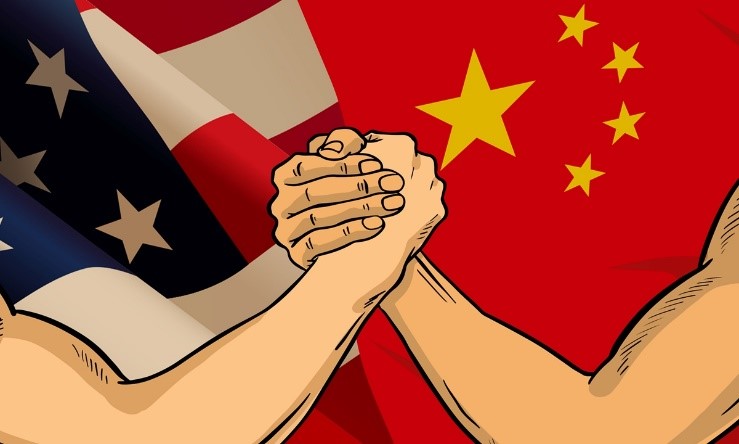
Strategic competition is the frame through which the United States views its relationship with China, in response to the direct challenges that China presents to U.S. interests.
The United States will address its relationship with China under the principles of reciprocity and fairness. The United States works to deter China’s aggression, combat China’s unfair trade policies, counter China’s malicious cyber activity, end China’s global trafficking of fentanyl precursors, mitigate China’s manipulation of international organizations, and promote accountability for China’s violations of human rights within China and around the globe.
Bilateral Economic Relations
The economic dimension of U.S.-China competition is crucial. U.S. goods and services trade with China totaled an estimated $643.2 billion in 2023. Exports were $195.5 billion; imports were $447.67 billion. The U.S. goods and services trade deficit with China was $252.1.4 billion in 2023. U.S. foreign direct investment (FDI) in China (stock) was $126.9 billion in 2023, a 3.8 percent increase from 2022. U.S. direct investment in China is led by manufacturing, wholesale trade, and finance and insurance. China’s FDI in the United States (stock) was $28 billion in 2023, down 6.2 percent from 2022. China’s direct investment in the U.S. is led by manufacturing, real estate, and depository institutions.
In its bilateral economic relations with China, the United States will place U.S. interests and the American people first and work to end China’s abusive, unfair, and illegal economic practices. China’s economy is one of the most restrictive investment climates in the world, including for U.S. investors, reflecting the country’s longstanding prohibitions on investment in key sectors and unpredictable regulatory enforcement. U.S. businesses consistently cite arbitrary legal enforcement, poorly defined legal terms and concepts, and a lack of regulatory transparency among the top challenges of doing business in China. China also engages in unfair trade practices, including using forced labor and massive state subsidies, putting American businesses at a disadvantage and making them complicit in China’s human rights abuses.
The United States is firmly committed to countering China’s licit and illicit efforts to obtain U.S. technologies to advance its military modernization, including through its military-civil fusion strategy; enhancing the United States’ leading edge in critical and emerging technologies, including artificial intelligence; and investing to rebuild the United States’ industrial base and ensure a future rooted in U.S. and allied technology, rather than untrusted technology from China and other authoritarian states. The United States is dedicated to countering the Chinese Communist Party’s (CCP) malicious cyber activity against U.S. government, private sector, and critical infrastructure networks to help protect American citizens, businesses, and industries.
China’s Role in International Organizations
Beijing assumed the China seat at the United Nations in 1971 and is a permanent member of the UN Security Council. Over the years, China has increasingly attempted to manipulate and subvert international organizations and standards setting bodies, including the United Nations and various regional fora, as tools to advance CCP goals globally. Beijing seeks to groom and install CCP members in leadership and other positions in international organizations; uses coercion and cooption to avoid accountability for its gross violations of human rights; and advance its interests at the expense of the United States and U.S. allies and partners.
Bilateral Representation
Principal embassy officials are listed in the Department’s Key Officers List.
The United States maintains an embassy in Beijing and four consulates in Guangzhou, Shanghai, Shenyang, and Wuhan, as well as an independent consulate in Hong Kong.
China’s embassy in the United States is at 3505 International Place, NW, Washington, DC 20008; Tel.: (202) 495-2266. China maintains consulates in New York, Chicago, San Francisco, and Los Angeles.