
By Keyu Jin
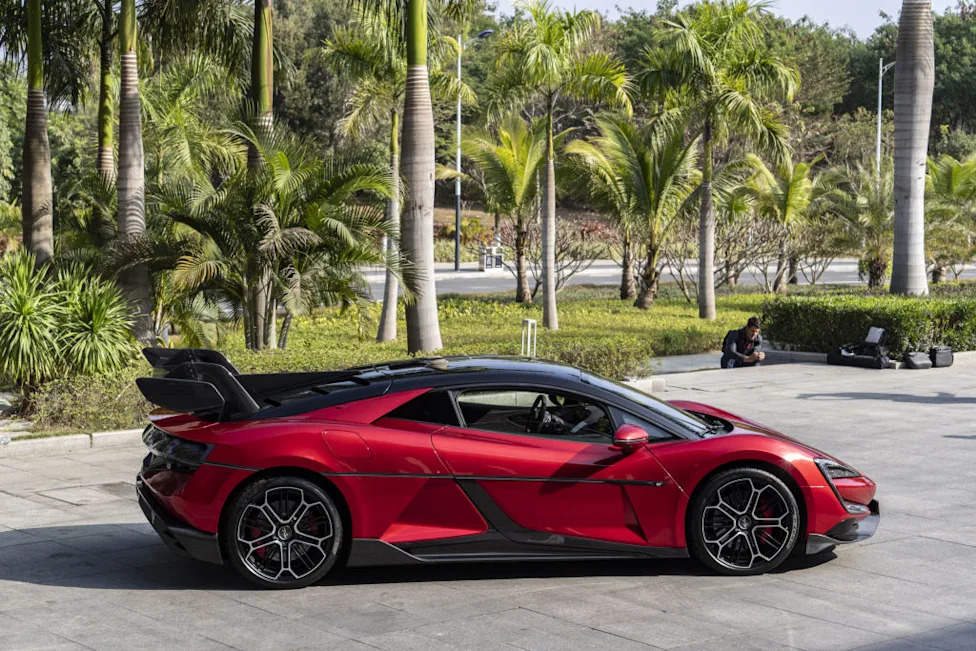
BYD debuted Yangwang U9, a high-performance fully-electric supercar pitted against Ferrari NV and Lamborghini, on Tuesday, Jan. 16, 2024, in Shenzhen, China. —Qilai Shen-Bloomberg-Getty Images
For four decades, China’s rise was built on an extraordinary bargain with the world. China offered labor, scale and, eventually, an industrial ecosystem of unparalleled depth. The world supplied technology, capital and markets. China became richer. The rest of the world got cheaper and increasingly better goods. By the middle of this century, that bargain will have to change. Not because China’s manufacturing model has failed, but because it has become too successful.
Over the past few years, the United States has imposed tariffs and export controls. Multinational companies have adopted “China plus one” strategies. Supply chain resilience has become a boardroom obsession. Yet China’s exports have continued to grow, helping to cushion its weakening domestic economy. Its goods trade surplus reached a record $1.2 trillion in 2025. But it would be a mistake to assume that this can carry on indefinitely. Increasingly, what is economically efficient is no longer politically tenable.
China’s manufacturing dominance is generating resistance. And not only in America. Europe worries about the erosion of its industrial base. Developing countries welcome Chinese investment and admire aspects of China’s development experience, but still ask a reasonable question: where, in this model, is our development?
Most countries do not simply want to buy Chinese electric vehicles, batteries, solar panels, machinery and robots. They want factories of their own. They want their workers to acquire new skills and their suppliers to move up the value chain. They want technology and know-how. For years, Western companies complained that access to China’s enormous market came with demands for technology transfers. Now, China finds itself on the other side of the table, being asked to share its own expertise.
China cannot indefinitely remain the world’s manufacturer indefinitely. Its great economic challenge over the next few decades will be to remain deeply embedded in a global economy increasingly shaped by protectionism and national security. The answer may lie in a new role: a shift from being the factory of the world to an exporter of industrial and technological capabilities.
The new China model
China’s real advantage lies no longer in cheap labor or subsidies, but in the accumulated learning embedded in perhaps the densest industrial ecosystem the world has ever seen. What China can now export is not just what it makes, but what it has learnt about how to make it.
The industrial ecosystem that China built around smartphones accumulated expertise in batteries, sensors, precision manufacturing and power electronics. Those capabilities then migrated into electric vehicles. EVs, in turn, spurred further advances in batteries, chips and automation. Automation fed into robotics. Knowledge compounds as it moves between industries, suppliers, engineers and firms. Each industry creates capabilities that make the next one easier to build. This is China’s innovation flywheel.
The important question now is whether that learning can travel. Neither Brazil nor Indonesia can recreate Shenzhen by decree. But they need not retrace the 30 years China spent building it. They can build on what China has already learnt. Chinese companies can bring machinery, engineers, production processes and supply-chain expertise with them. Local workers learn; local suppliers improve.
Knowledge that took decades to accumulate in China can thus accelerate development elsewhere. That would be a very different model of Chinese globalization: not simply exporting the products of China’s industrial ecosystem, but giving other countries access to the knowledge embedded within it.
Such a shift is already under way. In Brazil, BYD is moving from importing cars to manufacturing them locally and developing local suppliers. In Hungary, it is pairing its first European passenger-car factory with a research and development center that will work with Hungarian universities and companies.
In Indonesia, Chinese investment is helping to build an integrated battery industry stretching from nickel processing to battery production and recycling. These early examples point to a different relationship with the world: one based less on exporting what China makes than on exporting the capability to make it.
At first glance, this may sound like a loss for China. Why give up production at home? Why train tomorrow’s competitors? Because the alternative may be worse. Countries increasingly want options. They do not want their economic future to depend overwhelmingly on any single supplier, Chinese or American.
Source; Time