
By Ken Leong, AI content
How a Little Jar of Ointment Built a Chinese Business Empire
1. The little jar that conquered Asia
For generations of Chinese families, one item seemed almost indispensable: a tiny jar of 萬金油 (Tiger Balm).
Have a headache? Apply some Tiger Balm.
Mosquito bite? Tiger Balm.
Muscle ache? Tiger Balm again. It was almost as though Chinese families had discovered a universal remedy.
But how did this humble ointment become one of the most recognizable Chinese products worldwide?
The answer lies in the extraordinary life of 胡文虎 (Aw Boon Haw), a Chinese entrepreneur born in 1882 in British-ruled Burma, not China.
His story illustrates something remarkable: sometimes the greatest commercial innovation isn’t inventing a new product, but finding a way to bring an ordinary product to millions of people.
2. From a small Chinese pharmacy to a fortune
胡文虎’s father, 胡子欽, was a Chinese herbal practitioner who migrated from Fujian to Rangoon, today’s Yangon in Myanmar.
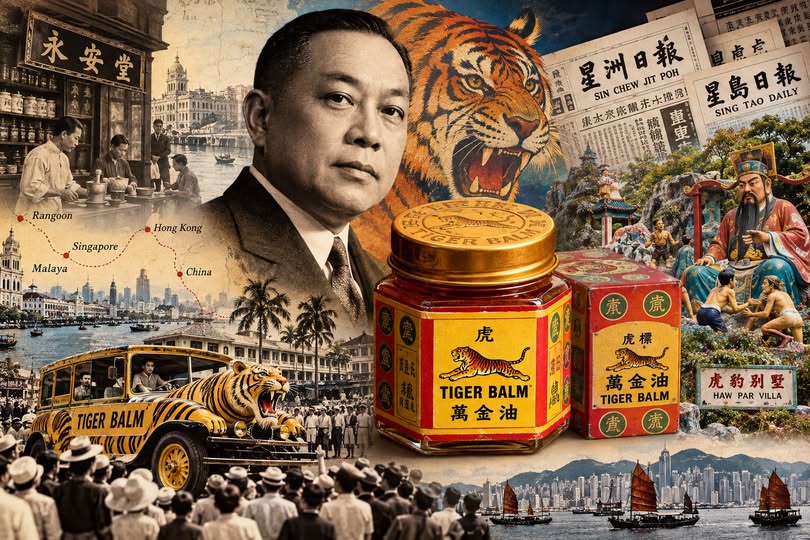
There he established a traditional Chinese medicine shop called 永安堂.
When he died in 1908, his sons 胡文虎 and 胡文豹 inherited the family business.
The brothers formed an effective partnership.
胡文豹 concentrated on production and developing medicinal products, while 胡文虎 concentrated on marketing, distribution and business expansion.
Together they developed and commercialized the ointment that became Tiger Balm.
Competing stories surround the precise origins of its formula, but the brothers’ commercial achievement is well documented.
3. The genius of selling a tiger
胡文虎 understood something that many traditional Chinese merchants overlooked.
A good product is not enough. People must recognize it, remember it and trust it.
He named the ointment 虎標萬金油—Tiger Balm—using the tiger from his own name.
- The tiger was a brilliant symbol. It suggested strength, vitality and power. It was easily recognizable even to customers who could not read.
- He also understood the importance of spectacle. His company used specially decorated automobiles with tiger heads and roaring horns to attract attention. Wherever these vehicles appeared, crowds gathered.
- Free samples introduced the product to new customers.
- Meanwhile, extensive newspaper advertising reinforced the brand.
In modern business terminology, 胡文虎 understood branding, distribution, publicity, and customer acquisition long before these became standard subjects in business schools.
4. The Chinese diaspora: a ready-made international market
Another key factor behind his success was the overseas Chinese communities scattered throughout Southeast Asia.
Chinese migrants had established communities in Burma, Malaya, Singapore, Thailand, Indonesia and beyond.
They shared languages, customs, family networks and familiarity with traditional remedies.
胡文虎 recognized the commercial potential of these connections.
In 1926, he moved the business headquarters to Singapore, one of Asia’s great trading ports. From there, Tiger Balm expanded throughout Southeast Asia, Hong Kong and China.
The product could cross borders far more easily than its makers.
A small jar of ointment became a symbol of the economic networks connecting overseas Chinese communities.
5. From medicine to newspapers
Once 胡文虎 accumulated substantial wealth, he expanded into a seemingly unrelated industry: newspapers.
He built an extensive newspaper network, including Singapore’s 星洲日報 and Hong Kong’s 星島日報.
Why would a pharmaceutical entrepreneur want to own newspapers?
The connection was not as strange as it first appeared.
Newspapers could generate revenue, advertise his products, build influence, and connect Chinese communities across national borders.
But they also gave him something selling ointment alone could not: a voice in public affairs.
He became not merely a businessman, but an influential figure in the overseas Chinese world.
By the time he died in 1954, his interests extended far beyond medicine.
6. The strange world of Tiger Balm Gardens
Perhaps his most unusual legacy was creating Tiger Balm Gardens in Hong Kong and Singapore.
These were no ordinary gardens.
They contained colorful statues depicting Chinese mythology, folklore, moral teachings, and terrifying scenes of punishment in the afterlife.
Visitors encountered stories about filial piety, greed, loyalty, temptation, and the consequences of wrongdoing.
Why would a man who sold ointment build such strange places?
Partly, they were spectacular advertisements.
But they also served as outdoor classrooms, introducing Chinese cultural traditions to ordinary people, including those with little formal education.
The Hong Kong garden has disappeared, although the historic mansion survives. The Singapore garden, known as Haw Par Villa, remains an important cultural landmark.
It combined commercial advertising, public entertainment, and moral education in an unusual way.
7. Wealth and responsibility
胡文虎 also became known for his philanthropy.
- He supported schools, hospitals, orphanages, homes for the elderly and disaster relief.
- His charitable activities extended across Chinese communities in several countries.
- He believed that wealth accumulated from society should also benefit society.
Of course, philanthropy could also strengthen a businessman’s reputation and social influence. These motives need not be mutually exclusive.
His career illustrates how successful overseas Chinese merchants sometimes provided public services in communities where government institutions were limited.
8. Was Tiger Balm really a miracle medicine?
One more question is worth asking.
Did 萬金油 really cure all those ailments?
Not exactly.
Tiger Balm contains ingredients such as camphor, menthol and aromatic oils that can provide temporary relief from certain aches and pains.
But it is not a universal medicine, and its historical claims about its many uses should not be confused with modern clinical evidence.
This distinction makes 胡文虎’s achievement even more interesting.
He did not need to discover a miracle drug.
He needed a recognizable product, a persuasive story, reliable distribution and a population that trusted the brand.
In other words, his greatest innovation was arguably commercial rather than pharmaceutical.
9. The larger lesson: entrepreneurship is a social phenomenon
胡文虎 died in 1954, but his little jar of ointment outlived him.
The business eventually became part of Haw Par Corporation, while Tiger Balm remained an internationally recognized brand.
His story offers several lessons about Chinese entrepreneurial history.
- First, overseas Chinese communities were not merely groups of migrants seeking survival. They also built commercial networks that supported international enterprises.
- Second, traditional Chinese products could succeed in modern markets through packaging, marketing, and industrial organization.
- Third, commercial success could generate influence far beyond business, extending into journalism, education, philanthropy and cultural identity.
- Finally, 胡文虎’s career challenges the assumption that modernization necessarily means abandoning tradition.
He took a traditional remedy and built a modern enterprise around it.
The product was old. The business model was new.
And perhaps that is the most remarkable part of his story.
A small jar of ointment, small enough to fit in a pocket, became the foundation of a business empire spanning much of Asia.
A final reflection
We often remember great entrepreneurs for their factories, inventions, and fortunes.
But perhaps we should also ask a different question:
What circumstances allowed these individuals to recognize opportunities that others overlooked?
胡文虎 was born into a Chinese migrant family in colonial Burma. He inherited a small pharmacy, operated within an extensive overseas Chinese network, and lived during an era when mass advertising, international trade, and modern manufacturing were transforming Asia.
His success was not simply the result of individual genius. It emerged from the interaction of personality, family, migration, technology, culture and economic opportunity.
And that is precisely what makes his story worth remembering.
History is not merely about extraordinary individuals. It is about the circumstances that make their extraordinary achievements possible.
#TigerBalmOintment #panacea #marketingstrategy #Aw Boon Haw #tigersymbol #SingTao #TigerBalmGarden