
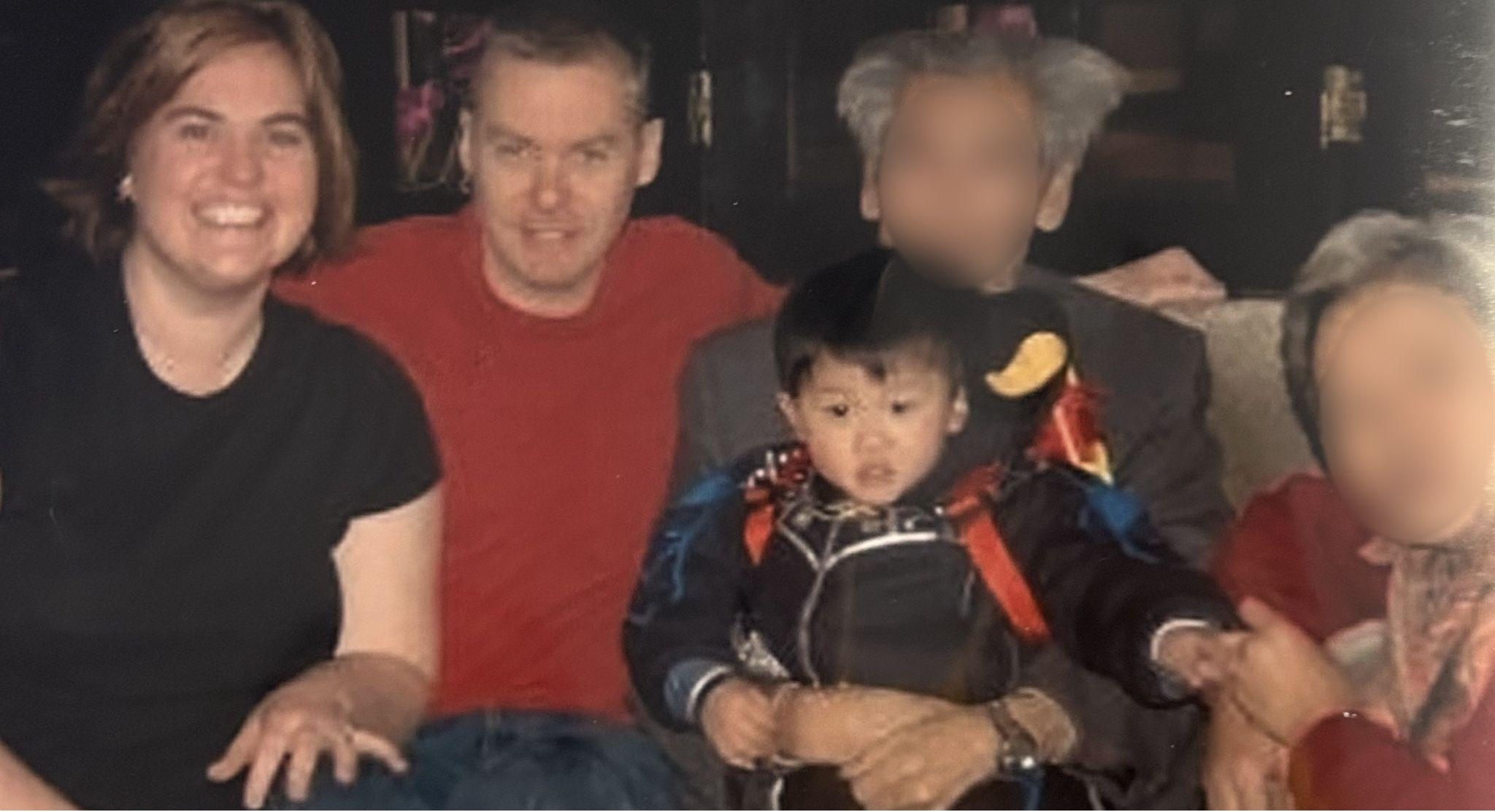
Figure 1: Joshua Hallgren (pictured in the middle) with his parents and foster grandparents.
By Jenny Liang, Associate Reporter at China Insight
Missing puzzles
“When I hear Chinese,” Joshua Hallgren tells me, “a part of my brain recognizes it.” He hesitates, eyes filled with longing.
“Part of my brain gets triggered, but I just don’t understand.”
Chinese was the only language Josh spoke before being adopted at two-and-a-half years old from Guiyang City in Guizhou Province, China.
As a second-generation Chinese immigrant, I had gone through a period of cultural dysphoria. For the longest time, I detested my slanted black eyes, boring straight hair, and my Oriental features. My journey towards acceptance took years, and as I became more involved in the community, I realized the sizable number of Chinese adoptees in the United States and became curious about their own journeys toward identity and belonging. Unlike them, I was raised in an immigrant family and community, with a grandma who couldn’t speak English. No matter how hard I tried to distance myself from my heritage, I was always submersed in Chinese culture.
In this project, I interview many Chinese adoptees, and question them on their ongoing voyage towards individual and cultural belonging.
What was it like to be adopted and raised in a transnational family? What unique challenges do these adoptees face, and how do they reconcile their nationality and culture with their ethnicity and origin?
Background
The global influx of transnational Chinese adoptees, and the causes behind that occurrence are complex. I knew the correct answers from my background in history and political science, as well my family background from Shandong (山东): After the Communist People’s Republic of China (PRC) was established following the Second World War, Chairman Mao Zedong sought to revolutionize the nation. While the West was rapidly industrializing through machine production, the most populated nation in the world was still agrarian and rural. Mao was painfully aware that China could not effectively compete and become a superpower without drastic measures.
Gaining inspiration from the Soviet Union’s Five-Year Plans, Zedong launched the nation-wide Great Lead Forward, backed by military force, to transform China “into a Communist paradise” (“China’s Great Leap Forward,” Association for Asian Studies). Cities became centers for mass production while the countryside was collectivized into sprawling communes. However, overinflated quotas and corruption led entire families to starve. Trees and grass were stripped bare before peasants turned to eating leather and soil, then their children (“China’s Great Leap Forward,” Association for Asian Studies). In all, an estimated 30 million Chinese perished
In the 1960s, the Chairman initiated the Cultural Revolution as a political movement “aimed to purge capitalist and traditional elements from Chinese society and to reassert Mao’s authority” (“The Cultural Revolution,” The National Archives). His Little Red Book [小红书] gained traction among students who became his Red Guard, and Mao Zedong their cult figure.
For years, the rising generation terrorized society through destroying “old ideas, old culture, old customs, and old habits” (“The Cultural Revolution,” The National Archives). Priceless historical artifacts and art pieces were demolished (How the Cultural Revolution Destroyed Chinese Traditional Culture,” CHN.Info). And it was during this period where my great-grandfather, a local village leader, was viewed as a threat to party supremacy and killed.
By now, Chinese society was hardly recognizable from where it was a century ago. Even though tens of millions had perished, the government was now concerned about overpopulation. “As China’s population approached one billion in the late 1970s, the government became concerned about what effect this would have on its ambitious plans for economic growth” (“Explainer: What was China’s one-child policy?” BBC News). The ambition China had to become a global superpower led to the largest movement in human history for national birth control, preventing an estimated 400 million babies from being born since its nationwide implementation in 1980 (“Explainer: What was China’s one-child policy?” BBC News).
The nation restricted most couples to having one child, enforcing the measures through fines, and threatening the confiscation of property (such as houses and cars) and jobs. Countless women were sterilized against their will and endured forced abortions, such as one of my aunts. The pressure was enforced heavily in Northern China, which lay under Beijing’s spectre of oversight. In Southern China, enforcement was more lax and many families got away with having two or more children.
Although the One Child Policy was repealed in 2016, and all couples are now permitted to have three children (as of 2021), with some provinces with no limit at all, decades of reproductive repression has dropped the national birth rate to 1.02 children per women (with 2.1 needed to sustain a nation’s population). Because of China’s long history of patriarchy and preference towards males to carry the family lineage, the One Child Policy unintentionally led to female infanticide, millions of girls and disabled boys being abandoned in favor for a healthy son, and an untold amount of sex-selective abortions (“Explainer: What was China’s one-child policy?” BBC News).
As BBC News reports, “China’s gender balance is skewed towards males as a result of this,” with an estimated 30 million more men than women (“Explainer: What was China’s one-child policy?” BBC News; “China: population by gender 2025, Statistica). The gender disparity led to an overabundance of bachelors in the countryside, as many women move to the cities for educational opportunities while the men stay back to manage family properties. Tragically, this has led to a concurring phenomenon of increased female sex trafficking rates (“Sex Trafficking and China’s One Child Policy,” China US Focus).
Because of the scarcity of women, families with daughters have also been able to leverage their 彩礼 (cai li), or bridal gift, which are material demands made to the groom’s family. Payments often reach tens of thousands of dollars, in addition to expectations that the groom owns a property and car, further decreasing marriage and birth rates (“The Price of Marriage,” ORCA).
But what about those untold millions of abandoned children, mostly disabled boys or daughters, who have become the casualties of this policy? Although Chinese transnational adoptions ended in 2024 because of population concerns, more than 160,000 Chinese children were adopted transnationally over a period of three decades: About half were adopted to the United States (“China ends transnational adoptions — some adoptees say they’re relieved,” NPR News).
These hundreds of thousands of adoptees, each with their own story and ambitions, are viewed as pawns in an international game for control by the two global superpowers. Amidst political and racial tensions, and the unique experience of growing up Asian in a Caucasian family and environment, how do these individuals find their own piece in the greater puzzle for belonging?
For the adoptees, I was curious if intentional cultural immersion was helpful or a hindrance in building personal identity and contentment. As for their parents, I wanted to know why they chose to adopt a child from China, and the unique challenges they faced raising a son or daughter from another cultural background.
In the first article of this series, I will be including stories from Chinese adoptees who were raised mostly or fully immersed in American culture, and my findings based on their experiences. Most of these adoptees cannot understand any Chinese, and were not enrolled in cultural activities, such as dance, music, or language classes.
Joshua Hallgren / 孔圣远 [Kong Shengyuan]
LinkedIn: Joshua Hallgren
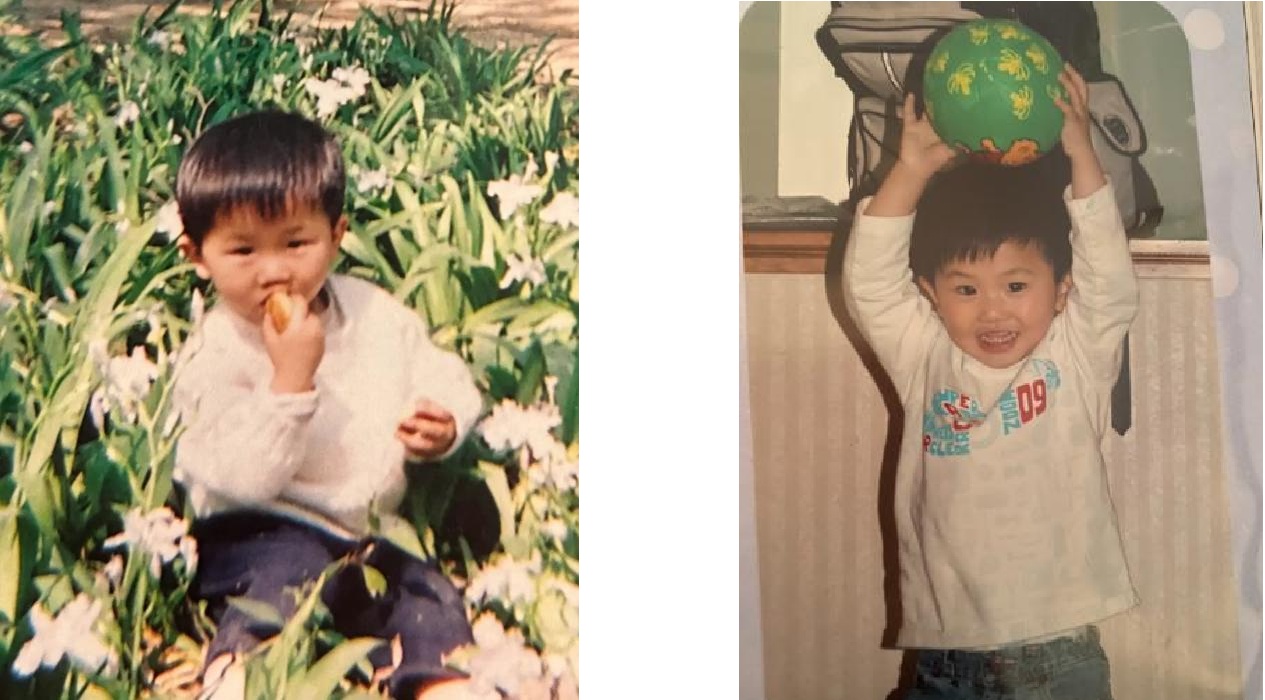
Figure Two (left): Josh as a child in China. Another childhood picture.
Watch an Interview Featuring Joshua’s Parents!
https://www.instagram.com/reel/DXXhqN-gaVV/?utm_source=ig_web_copy_link&igsh=MzRlODBiNWFlZA==
Joshua is a freshman at the University of Northwestern – St. Paul, and plays college football for the UNW Eagles. He is the only Chinese football player on the team. During his upbringing, he was one of the only Asian faces wherever he went. His features, dark eyes and straight black hair, made him the object of bullying. And, even in Chinese environments, Joshua felt left out.
Gaze darting, I could tell Joshua was trying to find a word to describe his turmoil of identity. “It’s like missing puzzles clicking. But it doesn’t fully click.”
Mr. Hallgren comes from Guiyang, the capital city of Guizhou. Guizhou is a mountainous, high-altitude province in the Southwest known for its cultural diversity. He was found in the metro station, abandoned beside a trash can. Being left in a high foot-traffic area likely lends a motive that his parents wanted their newborn child to be found and nurtured.
As noted by Yang, Xia, and Zhou in “Abandoned children in China,” “China experienced a wave of child abandonment from the late 1970s to the early 2000s, which peaked in 1990 and has since continued to fall. Girls were more likely to be victims of abandonment … [and] a large proportion of abandoned children are female or disabled.”
Joshua’s story fits that pattern. He was most likely abandoned because of an unspecified birth defect, he told me.
After spending a month or so in the orphanage, Josh lived with a foster “grandma” and “grandpa” for over two years. The days and nights blurred for the infant.
On the other side of the world, Mrs. Hallgren was a young, single woman who desperately yearned for her own children and family. A devout Christian, she was praying and suddenly became convicted after reading Isaiah 43:5:
Do not be afraid, for I am with you;
I will bring your children from the east and gather you from the west.
This verse prompted her to consider adoption. She knew that there were a lot of children in need of adoption from China (the “Far East”), and felt called to provide one with a loving family. At the time of adopting Josh’s older sister from China, she was engaged. The family of three was content for a few years, although their daughter had developed autism.
Certain they weren’t able to have biological children, Mr. and Mrs. Hallgren made the decision to adopt a second child. They utilized America World, a faith-based adoption agency “dedicated to building families according to God’s design for adoption while caring for children around the world.”
Ironically, they would welcome a third child biologically during Josh’s adoption process.
International adoption is notoriously pricey: The average cost for an American couple to adopt a Chinese child ranges from $25,000 to $40,000. International adoption fraud is a thorn in the practice’s rosy legacy. There are reported cases of child trafficking and stolen children, with the complicit agencies forging false histories and fraudulent documents to expedite the process. In opposition to private individuals and groups abducting vulnerable children for profit, legitimate organizations abide by the Hague Adoption Convention, or The Hague Convention on Protection of Children and Co-operation in Respect of Intercountry Adoption. Signed in 1994 by the United States, “the Convention establishes international standards of practices for intercountry adoptions” (Travel.State.Gov). The practice of matching parents with prospective children is done by a Central or public authority to reduce motivation for financial exploitation and protect the most vulnerable members of a population, orphan children.
For American families, the couple would begin by obtaining an international adoption professional, completing a Hague home study, file and obtain approval by USCIS (United States Citizenship and Immigration Services), await child placement with the international adoption agency, file a USCIS petition and adopt the child, obtain a valid immigrant visa, and meet and bring the child home (What is the Hague Adoption Convention? – Considering Adoption).
“Why China, out of all countries?” I asked him, curious. His parents knew there were a bunch of children who needed homes from China, Josh told me. “They wanted to give one a loving family.” There was no preference for region either.
When I asked Mr. Hallgren how his parents knew “he was the one,” he provided a faith-based answer. His mother prayed through the entire process, and told her son that she felt like the LORD was calling them specifically to him.
It was tangible, but hard to describe.
Upbringing
“How would you describe yourself?” I asked him.
“Chinese American. I don’t want to lose that part of myself.”
It wasn’t easy being the only Chinese kid in a community, especially when your family members don’t share the struggle of looking markedly different from everyone else. In a sea of blond or brunette hair and blue eyes, having darker features makes one stand out instantly.
Josh was no exception, and consistently experienced racist remarks and harassment from his classmates. In his first experience in the outside world, as a first grader at a private Christian school, Joshua clearly remembers a kid walking up to him, squinting his eyes, and telling him: “Look, I’m Chinese too!”
“A lot of kids would do that,” he told me.
Although his parents were upset, they didn’t bring it up to the school.
The bullying continued throughout middle and high school. Kids would squint their eyes, purposely bump into him in the halls, make fun of his “flat face,” call him a Communist, and tease Joshua about eating dogs. And it wasn’t just Caucusian people. When their family moved schools in Michigan, he was enrolled in a school district that was primarily black. There, jokes regarding his Asian features only amplified, and the district ignored complaints. Although most people were ignorant and making jokes, there was a minority that were malicious.
Joshua would observe how when other students’ families complained that teachers were racist, the district would actually fix things. “It hurts,” he told me. “Racism towards Asians wasn’t seen as a problem, while it was seen as an issue with other minorities. Asians are seen as more calm and timid. An easy target that won’t speak up.”
As he became involved in football, kids would yell slurs during practice, notably “ching chong” and “chink.” And, when he brought complaints to the district, the administrators would claim to address the problem and talk to the bullies.
And, each time, nothing would happen.
When he entered the University of Northwestern – St. Paul, the jokes continued, although the majority of students would stop once he told them to. Even so, he always felt left out. In Asian groups, he felt “not Asian enough.” In Caucasian groups, he felt “too Asian.”
“I always feel left out. I don’t feel Chinese or American. It’s like I’m between both worlds.”
“Have you ever heard of the banana archetype?” I asked. “We’re yellow on the outside but white on the inside.” Joshua agreed.
As a member of the football team, Mr. Hallgren feels like he has to prove himself. After all, there aren’t many Asians who play football. In 2023, Asians made up 6-7% of the American population, but made up only 0.1% of the NFL (Associated Press, “How Asian American and Pacific Islander athletes in the NFL express their cultural pride”). In comparison, Asians make up 21% of American biomedical faculty (Cell, “Asian Americans in STEM are not a monolith”).
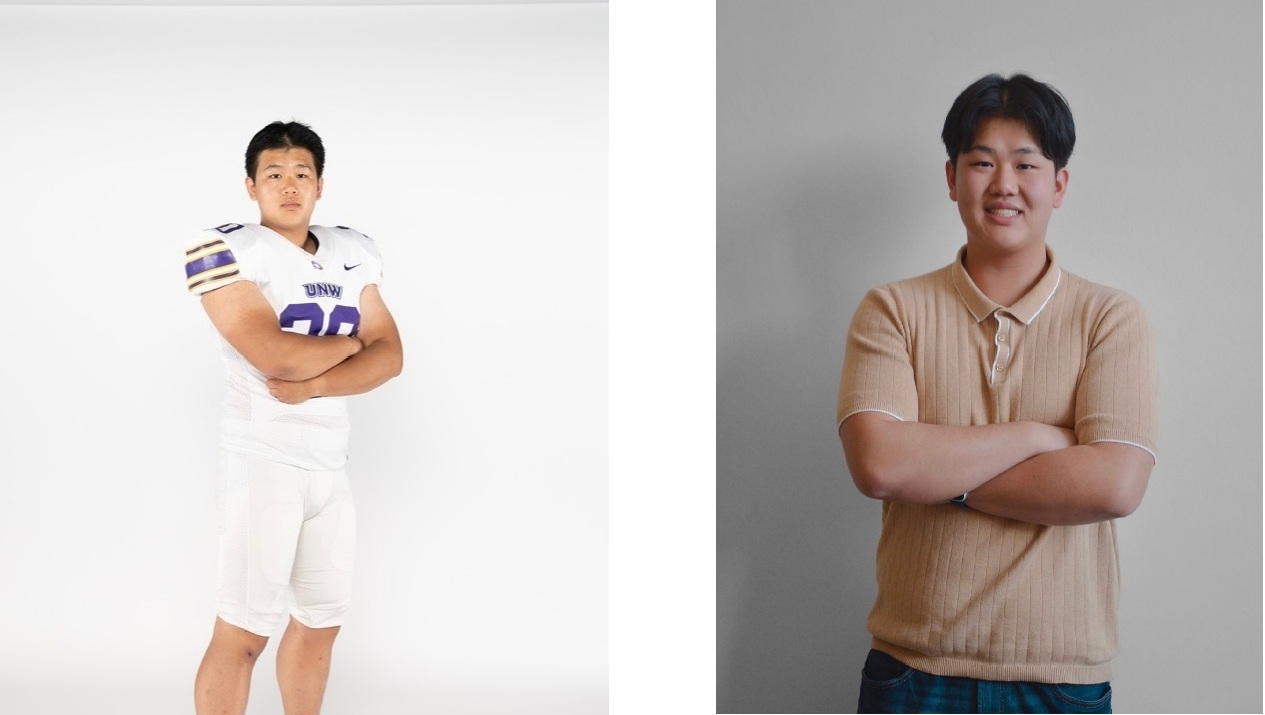
Figure Four (left): Football portrait.
Figure Five (right): Joshua is also a Biology major and President of UNW’s Asian Student Fellowship
Now, Joshua Hallgren balances his time between pursuing a degree in Pre-Med (Biology), spending time on the football fields, and leading the college Asian Student Fellowship (ASF). As a freshman, he became the club President, and leads initiatives on cultural belonging and events focused on Asian food and holidays. He aims to become a Physician’s Assistant:
“I want to be a top physician’s assistant working with either children or at a major hospital to show patients the love of Christ through the medical field. I hope to one day have a family as well and raise my family up through faith. I want to use my story and life as a testimony to others so that they might have a similar passion for Christ as well.”
“What is something you wish your parents did differently?” I asked him.
“I wish my parents involved me more with my heritage.”
I remembered his comments about puzzle pieces; how Mandarin sounded so familiar yet foreign at the same time. Being in a sea of similar faces and features, but completely alienated. Sharing heritage without experiences. He originally didn’t cope with his anger well and took out his confusion on himself and his parents. It was a long journey towards forgiveness, much of it due to his strong Christian faith.
“If I could speak to my younger self, I would tell myself to be more confident and be less hard on yourself – love yourself more.”
As I listened to his story, I found it beautiful how Joshua Hallgren is actively reclaiming his identity through relearning the language he grew up hearing and leading a college organization to help others do the same.
Finding the missing piece in their puzzle.
Update from Joshua Hallgren (April 2026):
Despite me yearning for those cultural connections and friendships, I have learned to whole-heartedly put my faith and identity in Christ Jesus alone. From when I was first interviewed God has taught me so much, along with giving me multiple opportunities to lead and impact the lives of others like me! God has given me a solid group of friends who push me in my faith and it’s everything I could have asked for. I have learned that as cliche as it sounds, God gives us what we need, not what we want. Next school year I will be ASF president again, filming for football due to too many injuries, and along with being a multicultural mentor and orientation leader. I have been given an amazing opportunity to serve those who may be transracial adoptees like myself, those who need friends, or those who need to be challenged. Throughout this process, I learned that when I put my sole identity in being an athlete, asian, or wanting to be white, it ultimately failed me because I can never live up to others or my own expectations. God has made me uniquely me! I come from a diverse background to bridge the gaps between my cultures. I am ultimately excited to see where God leads me from here, I know he has good plans for me.
Robin*
An (asterisk) * depicts that the interviewee’s name has been changed for their privacy.
All pictures provided property of the interviewees.
Robin*, a Guiyang adoptee, describes a similar experience. When asked how much Chinese she understands, she replied, “literally zero.” Like Joshua, Robin* described periods of identity turmoil as an adolescent, where she felt isolated and alone in her experiences. She was adopted around Guangxi province, an autonomous region which borders Vietnam.
Like Josh, Robin* has no information on her biological parents. It was “very secretive,” she told me over the phone. “One day, I showed up outside the orphanage in a blanket.”
Robin* was adopted before her first birthday and has no memories of China prior.
The reason Robin* was adopted, interestingly, was due to her older brother: While praying with his parents, her brother suddenly wanted a baby sister. Yet, because of a medical reason, their parents were unable to have more biological children. Faced with an intense longing to grow their family, adoption seemed like the obvious pathway.
“Why China, then?” I asked. “Out of all possible countries to adopt from?”
As a religious household, another family in their church had adopted from China. It seemed to be the direction God was leading them through prayer, Robin* observed. All her parents wanted was a healthy baby girl. Her mother already had health conditions, and the middle class family couldn’t afford a child that needed pricey medical treatments.
The adoption process took almost a year, and her parents prepared through reading books and talking with church friends. “They did what they could,” she stated.
While the family was in China, they explored tourist attractions. Her brother, a redhead, drew much attention from the locals, who had never seen someone with red hair before. When it came time to meet the newest addition to their family, Robin* was confused and wouldn’t stop crying during their first meeting. As if a sign of good fortune, she soon stopped after her dad scooped her up into his arms.
Soon enough, Robin* joined the family’s life in Sioux Falls, South Dakota. It was never a secret that she was adopted: “My parents,” Robin* said, “never wanted me to not know.” She distinctly remembers watching the PBS Super Why! series (which features superheroes that teach children how to read), and learning about adoption in the “Juan Bobo & The Pig” episode.
Growing up, her parents attempted to immerse her in Chinese culture: Once a year, they would take her to New Year exhibitions. Without a Chinese community, they tried to teach her some Mandarin, although they themselves struggled learning the language. They also got Robin* some traditional clothing. But the efforts waned as she grew older.
“It wasn’t the most immersive. I wish it had been more. I wish I knew more about my Chinese heritage and culture.” Her voice was filled with regret.
Like many transnationally adopted children, Robin* went through a massive identity crisis. She didn’t have the strongest relationship with her parents, and felt confused and lost. Why was she adopted into Sioux Falls, a place where nobody looked liked her? She was also resentful of the lack of Asian influence in her life, and her inability to speak Chinese.
Her relationship with her brother was also rocky when they were younger. While she was extroverted, her brother was more reserved and quiet. They treated him differently and were “better equipped to deal with his problems,” which caused resentment and jealousy. Although she and her brother both live in Minnesota now and are able to hang out and have fun, it’s still difficult to connect with her parents.
“I remember crying a lot.”
“I don’t look like them. They don’t understand me the same way.” She has attempted to share some of her struggles with her parents, but “there’s only so much they can understand.”
As a person of faith, Robin* remembered feeling shocked after realizing that China is majority atheist/agnostic. She often used to wonder about her birth parents, and realized that there was almost no way she could successfully track down her biological family.
“I wish I knew something about them,” Robin* said. “It felt scary.” What if she had an argument with her family? Where would she go? What would she do?
When I asked Robin* if she would look for her birth parents, she paused. She wants to try, but hasn’t done the research yet. “I feel like I’m not ready. But, the longer I wait, the higher the chance that they moved or passed away.”
Her emotions are less intense now, and Robin* is mostly curious to know who her biological parents are and what they’re like. “When I look at my brother and how he acted and how my parents act, it makes sense because they’re related.”
“But when I look at myself, I don’t know…”
We talked about the nature vs. nurture paradigm, and if children inherit more traits from genetics or upbringing. It’s devastating, she says, not knowing how she compares to her biological family.
She was one of the only people of color in her private Christian school. There wasn’t a lot of diversity, which the young girl struggled with. In hindsight, “public school would have been more fun.” She got in trouble a lot and the teachers were mean, but it was hard to say if it was a race thing, as Robin* was very social.
The Chinese adoptee also encountered microaggressions, such as comments made about her eyes. “Those were hurtful,” she said, “but it didn’t happen a lot.”
She decided to attend the University of Northwestern – St. Paul for her undergraduate education, majoring in theatre and occasionally landing acting roles in productions. Despite being a South Dakotan, her mother and brother both went to Northwestern and she was intrigued by the theatre department and Minnesota’s cultural diversity.
After arriving for her freshman year, the transition was difficult. The campus diversity was a far cry from the diversity shown in promotional flyers. She was also landlocked to campus without a car, and was stuck in a small college in a whole new state.
As a theatre major and actor, I was curious if her race played a factor in the roles she was cast for. “It’s hard to say.” Sometimes, Robin* suspected that she didn’t get a certain role because of her Asian features. “There is hesitancy for well-known shows,” where characters are expected to look a certain way. But some directors, she told me, were very accepting.
“Why theatre then,” I asked, “knowing how the industry is often hostile to minority actors?”
When she was younger, told me that she struggled with reading and academics. Her father, Robin* said, read to her a lot, which instilled a lifelong passion for words and reading.
“Were there ever moments where you wished you looked different?”
Robin* responded immediately. “Auditions. I sometimes wished I could play the part.”
Now, Robin* considers herself an American Chinese, even though she views her relationship with China as “estranged.” She wants to learn more about her identity and culture when she’s ready, including teaching herself Mandarin. She didn’t have time during college, where she was busy practicing for shows, taking classes, and working. Although she never lacked friends, in hindsight, Robin* wished she made more Chinese friends. Even so, she is much more confident now, more satisfied and alright with her life situation. When she had the money, Robin* told me, she wanted to visit China.
“I believe I found inner peace.” Maybe that would change if she dug around more, she noted. “If I’m busy and don’t think about it, it’s fine.”
I believe her desire, as a woman of color, to find belonging in the performing arts led to her career mission: teach high school theatre. Robin* has a burning mission to have more inclusive productions and interest students from more cultural backgrounds to join. “It is important to have a plan for cultural immersion, to try to have a plan to intentionally help them with their culture.”
In addition, she is interested in adopting in the future. China is an option, Robin* remarked, but she would consider anywhere international or domestic. “I believe adoption is so powerful.” There are many children without homes, and she feels compelled because of her background story and personal faith. As an adoptee, Robin* values human life. “I could have been aborted,” she says. “If we want fewer abortions, we need to do something about it, not just protest or yell at someone. Let’s adopt.” Robin* considers adopting from China so she can provide her child a good experience, as she could personally understand how they feel.
She currently works at Booster, a fundraising company, but dreams of writing a play in the future.
“I’m just me. Being Chinese is a part of me. Let’s celebrate our differences.”
Lily Hubbard
LinkedIn: Lily Hubbard

Figure Six (left): Lily competing on the hurdles. Figure Seven (right): Lily Hubbard is a high jumper.
“Jump high brother!! So high that if you fall, then people should remark on not how far you fell but how high you jumped.”
This quote by Anubhav Mishra fittingly describes the beauties of the high jump and hurdle disciplines. It takes a certain bravery to propel your body through the air, squeezing your eyes shut and hoping that the hours of sweat and toil were worth the pain.
Lily Hubbard is a Mosaic diversity scholar and Biochemistry major at the University of Northwestern, where she also competes for the track team. Lily was adopted from Nanchang, China, a city in the inland Jiangxi province. She was adopted at 13 months, and has no memory of her biological family or why she was abandoned.
“I don’t really know anything,” Ms. Hubbard admitted. “My mom tells me it was likely because of the population.”
She had a simple upbringing. “My first memory was waiting with my parents for my brother to get off the bus.” Like Josh and Robin*, Lily always knew that she was adopted.
“How did you find out?” I asked her.
“One day, I gained consciousness.” I laughed. It was such a fitting phrase.
Lily’s background was never a mystery in the Hubbard family. Her mother used the family scrapbook as a vehicle to tell her story. The Hubbards were Norwegian, and their daughter’s Chinese heritage wove right into the family mosaic. She had three older biological siblings, two brothers and one sister. Her siblings were much older, but the Hubbard children were close and had normal sibling dynamics.
Lily grew up in the suburbs of Minnesota and went to a Spanish immersion school that offered a Chinese program for two years. Her school had little diversity, but she rarely felt different than her peers. She didn’t experience micro-agressions, at least not on a daily basis. Ultimately, her family withdrew her because the academic program wasn’t good. She also took Chinese dance for a few years at Twin Cities Chinese Dance Center (TCCDC) and enjoyed cultural immersion. When asked to rate her Chinese fluency out of ten, Lily gave a 2.5. “I can understand basic Chinese,” Hubbard laughed.
I was curious about something. “Your parents have three biological children. Why did they choose to adopt?”
Her mom, Lily told me, always wanted to adopt and provide a home for a child, although she wasn’t sure why her parents chose to adopt from China. Faith was most likely a factor though. Lily is adamantly pro-life because of the circumstances of her adoption. “Adoption is important,” she told me, because there are so many abortions, and many kids can be adopted.”
She remembers an interesting story during her adoption process:
Her parents were at the adoption building, and for some reason, the babies and their caretakers were lined up on the opposite wall. While the parents were standing across the room, filling out legal paperwork, they remember Lily staring them down from the other side.
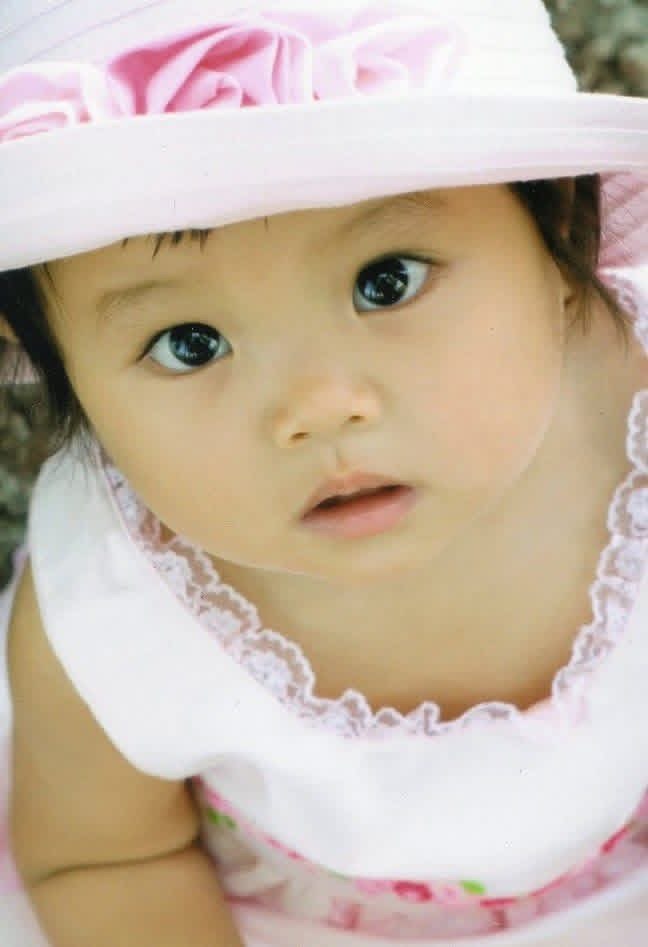
Figure Eight (top): An adorable baby picture of Lily.
Lily Hubbard has not been back to China ever since. As a child, she simply wasn’t interested. Now, she would like to walk around the area she was adopted and visit the Great Wall. A trip to pay homage to her heritage and have fun.
Unlike many of the other adoptees interviewed, Lily had no active interest in finding out who her birth parents were, nor is she angry at them. Sometimes, feelings of curiosity would emerge and Lily would wonder if she has biological siblings.
She considers herself “mainly American.” When I asked her if she had ever experienced a crisis over identity, Lily couldn’t think of a time.
“I want to say no. Sometimes, I forget that I’m Asian. Sometimes, I think about it deeply.”
When I asked if her physical appearance played a role in how others treated her, she told me that she was oblivious. “I feel like I belong.”
Now, Lily is making an effort to connect with her heritage. Last year, she joined a Chinese language group at UNW. She retained a lot more than she imagined, she remarked happily. As she is having fun, Lily Hubbard has been trying to understand when Mandarin is spoken around her (then becomes slightly disappointed when she can’t decipher conversations).
When people ask her where she’s really from, she just laughs it off. Although Ms. Hubbard used to wish she had a different background, she is now “really happy to be adopted.” As a Chinese adoptee, she remarked, there are “two worlds she can explore” and “so many things she can look into.” Lily Hubbard is a Chinese adoptee to a family with Norwegian ancestry in America. Lily enjoys making lefse boards, eating lutefisk, and celebrating St. Lucia’s Day. She also mentioned wanting to adopt from China in the future, if possible.
In addition to her hobbies and studies, Lily Hubbard is an athlete: Ever since she was a Freshman in High School, Lily has been involved in competitive track. Now, she competes in hurdles and the high jump for the Northwestern Track & Field team. Hubbard also competed in rhythmic gymnastics and played the violin for 16 years.
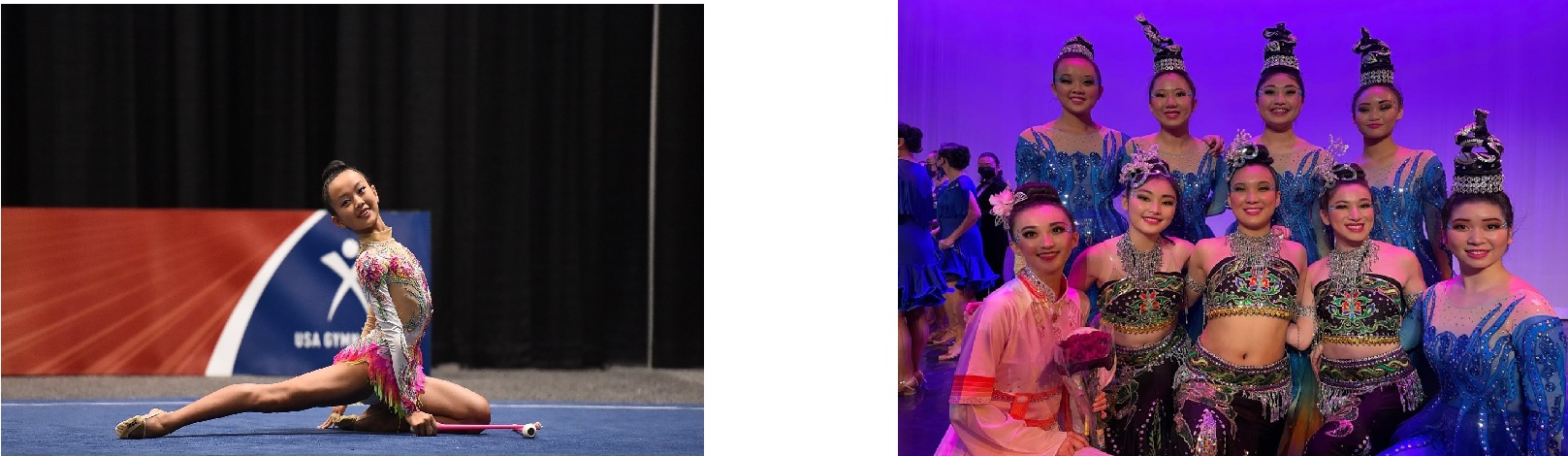
Figure Nine (left): Lily competing in rhythmic gymnastics. Figure ten (right): Lily is the top left dancer
After hearing about UNW’s Postsecondary Enrollment Options (PSEO) program, which allowed high school students to earn college credits for free, Lily Hubbard enrolled as a PSEO student. She made the decision following high school to continue at UNW after becoming a Mosaic scholar, a scholarship which seeks to place students with diverse backgrounds into leadership programs. As a Mosaic scholar, Lily has been a part of initiatives featuring various dining customs and sharing the experiences of adoptees to the wider student body.
“Adoption itself,” she told me, “is its own culture.”
Lily is now a senior, majoring in biochemistry. She enjoys working in the labs, and finds research stimulating. She dreams of making a big impact in her field.
“What would you want the world to know about you?” I asked as we sipped our coffees together.
“I would like someone to really understand me and my experiences in specific moments. Just because I don’t say something, doesn’t mean I don’t have a strong opinion.”
I asked her, “If you could speak to your younger self, what would you say?”
“Stay in the Chinese immersion school.”
“You’re doing it just fine.”
Additional Resources
- Follow this ongoing Chinese adoptees series on China Insight!
- You can read more about me in my memoir: The Phoenix and the Eagle, Growing up in America – China Insight
- Author Linktree: Jenny Liang Official: Instagram | Linktree
- Author Google Scholar: https://scholar.google.com/citations?user=tHrOBesAAAAJ&hl=en
Sources
- China’s Great Leap Forward – Association for Asian Studies
- The Cultural Revolution – The National Archives
- How the Cultural Revolution Destroyed Chinese Traditional Culture
- Explainer: What was China’s one-child policy? – BBC News
- China: population by gender 2025| Statista
- THE PRICE OF MARRIAGE
- Abandoned children in China: the son-preference culture and the gender-differentiated impacts of the one-child policy | Humanities and Social Sciences Communications
- America World | Building Familes, Caring for Children
- Understanding the Hague Convention
- What is the Hague Adoption Convention? – Considering Adoption
- How Asian American and Pacific Islander athletes in the NFL express their cultural pride | AP News
- Asian Americans in STEM are not a monolith: Cell
Publisher’s Disclaimer:
The opinions expressed in this article are solely the views of the author and do not necessarily reflect the opinions and beliefs of China Insight. The information presented is provided for general informational purposes only. While every effort has been made to ensure the accuracy and reliability of the content, the publisher claims no responsibility in the conclusions set forth by the author, who can be reached at [email protected].