
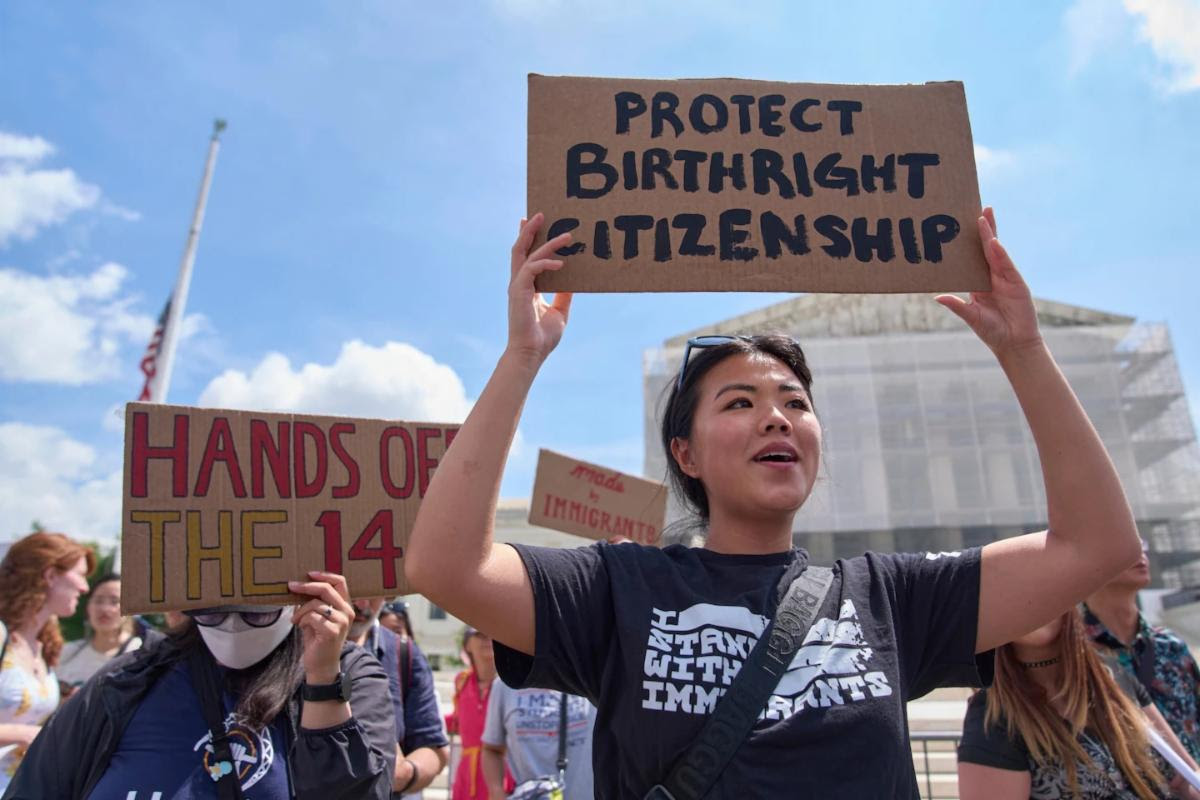
The Trump administration’s Supreme Court briefs against birthright citizenship rely heavily on 19th-century white supremacist scholars, including a Confederate officer who argued for “separate but equal,” the recycled arguments rejected in the 1898 Wong Kim Ark ruling.
The Washington Post reported on March 30 that the Trump administration, in its legal documents submitted to the Supreme Court, extensively cited the arguments of 19th-century white supremacist scholars in an attempt to overturn the long-established principle of birthright citizenship in the United States. The most crucial source was Alexander Porter Morse, a Confederate officer who defended the legalization of racial segregation in the 1896 case of Plessy v. Ferguson, establishing the infamous “separate but equal” principle. In his 1881 writings, Morse argued that the Fourteenth Amendment’s phrase “subject to the jurisdiction thereof” excluded children of foreign nationals from citizenship. The report states that the Chinese American Legal Advocate (CALDA) submitted an amicus brief, pointing out that the Department of Justice cited such scholars’ arguments in at least 19 places. These arguments were rejected by the Supreme Court in the 1898 case of “United States v. Wong Kim Ark,” which stated that the government was “reclaiming a losing argument based on racism.”
On April 1, the Supreme Court held oral arguments in the case of Trump v. Barbara, focusing on the meaning of “subject to its jurisdiction” in the Fourteenth Amendment. Trump became the first sitting president in U.S. history to personally attend oral arguments before the Supreme Court. The government’s attorney, D. John Sauer, argued that the amendment requires parents to be permanently and legally residing in the United States for their children to obtain citizenship. Cecillia Wang, the ACLU attorney representing the plaintiffs, countered that the Fourteenth Amendment establishes a “clear line” covering almost all those born in the United States, excluding only the children of diplomats and enemy military personnel. A majority of the justices, including several conservative justices, questioned the government’s position.
This case touches upon the historical memory and current interests of Chinese Americans. In the 1898 case of Wong Kim Ark, the Supreme Court ruled 6-2 that Wong Kim Ark, the son of Chinese immigrants in San Francisco, was a U.S. citizen, establishing the principle of birthright citizenship. The CALDA opinion emphasizes that the 19th-century movement against birthright citizenship was rooted in systemic racial discrimination against Blacks and Chinese after the Civil War.
After leaving the courtroom midway through the proceedings, Trump posted on social media that the United States was “the only stupid country in the world to allow birthright citizenship,” but in fact, about 33 countries worldwide practice this system.
Source: UCA, Washington Post, NCSU