
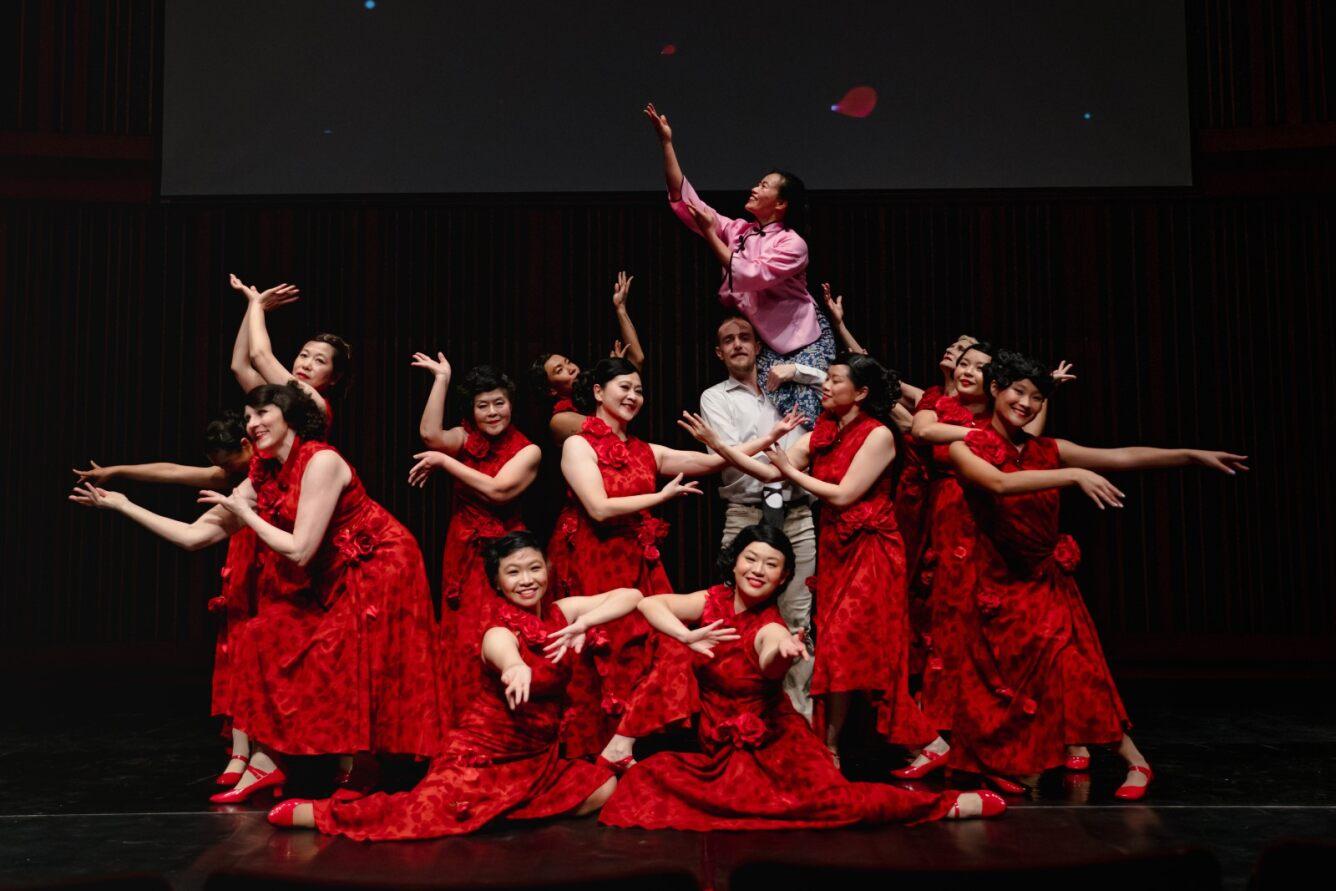
Above: Elena Youngdale and Malcom Peterson surrounded by dancers, from an excerpt from Shanghailander. Shanghailander is a fictional production where Caleb, a jewish violinist (Malcolm) seeking refuge in Shanghai, is tortured during World War II by the Japanese and finds the hope of love through Rose, a Chinese girl (Lan).
By Jenny Liang, Associate Reporter at China Insight
* All pictures unspecified property of Jijun He
Few people groups have gone through as much bloodshed as the Chinese. Relative geographic isolation spotted by mountain ranges and the Tibetan Steppes dampened foreign threats, and the winding Yellow and Yangtze rivers provided a lifeblood to an agrarian civilization. It was in this prosperity that Chinese culture developed alongside the dynasties, with a character-based writing system, the rise of Confucianism and Taoism centered on filial piety and honor, and traditional calligraphy and music.
Nowhere is the depth of Chinese philosophy and dedication to the arts more apparent than in music: The two-stringed snakeskin erhu (二胡) has an hanutingly emotional cry and harbors the closest tone to the human voice, mimicking human sobs as well as the galloping of horses in the wilderness. The pipa was a favorite in the courts and was considered the “King of the Chinese Musical Instruments” (A Wonderful Sound From The Heaven). The pipa is laden with symbolism: The four things represent the four seasons, while “its size of three feet and five inches reflects the three realms—Heaven, the earth, and man—and the five elements—metal, wood, water, fire, and earth” (A Wonderful Sound From The Heaven). Meanwhile, the guzheng’s plucked and pressed melodies, similar to a Western harp, allows for a waterfall of sound (The Bamboo Grove). The guqin is similar, but only has seven strings.
Other instantly recognizable instruments include the bamboo dizi, an airy and “resonant” counterpart to the Western flute, with many different keys, sizes, and lengths (Chinese Dizi). Lastly, the hammered yangqin is a staple in the Chinese orchestra, and provides an upbeat and joyous base to the melody (Chinese Yangqin).
Many of these instruments, the foundation of Chinese artistry, complemented dancers from the Shen Pei Performing Arts Alliance in their December 2025 “From Ashes to Roses” production in Mairs Concert Hall in Macalester College.
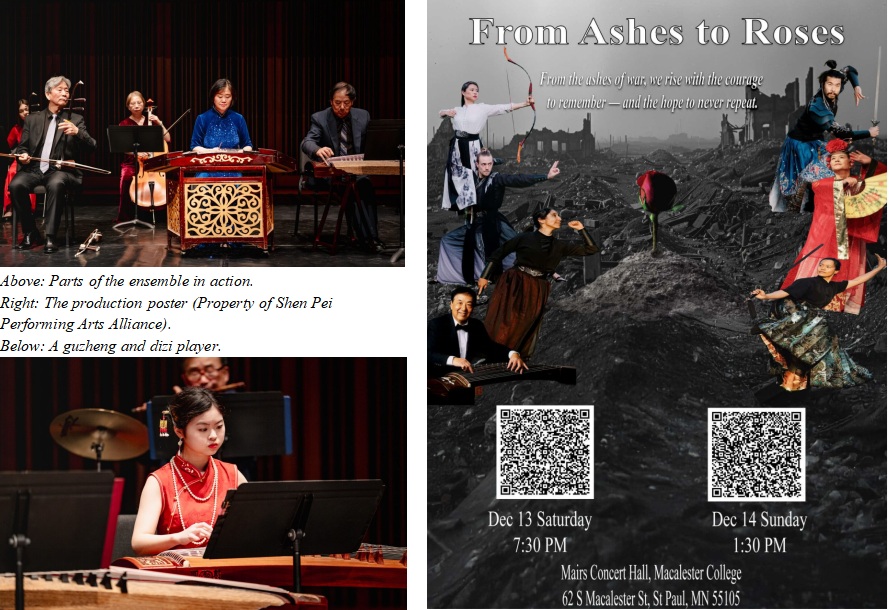
“I’m proud to be Chinese.” Starry Wu, the founder of the Shen Pei Performing Arts Alliance, told me resolutely. The Chinese civilization, she told me, is one of the world’s oldest, with the first dynasty being the Xia from 2100 to 1600 B.C. (Timeline of Chinese History and Dynasties).
The Han have also arguably encountered more bloodletting than any other ethnic group: Almost 30 million died during the decades-long fierce schisms of the Three Kingdoms Warlord Period (World History Edu). The worst famine in recorded history was during the Great Leap Famine from 1959 to 1961, where 16.5 to 40 million starved to death due to forced industrialization (Guinness World Records). And during the Second World War, Republic of China suffered the worst losses after the Soviet Union, with three to four million military deaths and sixteen to seventeen civilian casualties (The National WWII Museum | New Orleans).
The most devastating occurred during the forced Japanese occupation, rape, and massacre of innocent civilians, notably in the Rape of Nanjing in 1937. Characterized as the “Chinese Holocaust,” Japanese soldiers used “living POWs for bayonet practice, mowing them down in large swaths via machine gun fire, decapitating, and burning the men alive” (TheCollector).An estimated 20,000 to 80,000 women were brutally raped, murdered, and mutilated. At the end, an estimated 200,000 civilians perished in the six-week siege.
Worst of all was the Unit 731 experiments, where almost 3,000 Chinese civilians were used as guinea pigs and referred to as maruta, Japanese for “wooden logs” (Shedding light on Japan’s WWII germ warfare program : NPR). No prisoner survived, and the Japanese destroyed all records (Experiments – UNIT 731). Even today, the Japanese government has not issued an apology or recognized their atrocities.
Despite such pain, the Chinese have continued to persevere. Despite being threatened with extinction, with the flames of the Chinese identity repeatedly doused into ashes, an ember of resilience has always remained. The December 2025 “From Ashes to Roses” production seeks to bring a light to the resilience and beauty of the Chinese people.

Left: Shen Pei, the mastermind behind this production.
Right: A heartwarming dance between Caleb and Rose.
Starry Xin Wu is the founder of the Shen Pei Performing Arts Alliance, alongside her critically acclaimed mother, Shen Pei. When Mrs. Pei immigrated to Minnesota, she brought “decades of experience and an international reputation as a dancer, choreographer, theater artist, theorist and educator. Many of her award-winning choreographed works, such as Plum Blossom Triolet, have been performed throughout the U.S., Europe and Asia” (Chinese Heritage Foundation).
As China’s long history shows again and again, you can’t extinguish the Chinese people. After each disaster, the Han people stand up taller, their spirit more determined to survive.
The performing arts center seeks to promote the beauty of Chinese culture through the universal language of dance: “Dance language is the most primitive common language of human beings” (Performing Art). The universal language of dance, the raw and physical expression of human history and culture, is something that Shen Pei channels in her productions:
“Shen Pei’s masterpieces are Chai Cha Dance《采茶舞》and Zhi Wang Dance《织网舞》, which both represent scenes of Chinese labor. Chai Cha Dance, Mrs. Wu said, “is based on the scene of picking spring tea in the tea gardens of Zhejiang Province during the spring season.” Zhi Wang Dance, on the other hand, “was created based on the observations of local fishermen mending fishing nets while the author was conducting research in the fishing areas of Zhoushan, Zhejiang Province during that time.”Shen Pei’s renowned productions are so cemented into Chinese popular culture that they are instantly recognizable by China’s Generation X.
On the 80-year anniversary of the ending of WW2, “From Ashes to Roses” seeks to use Chinese culture through dance and music to “honor stories from history, call for compassion and hope, and encourage support within and beyond our community to work through trying times” (From Ashes to Roses). The Jewish refugee Caleb was beautifully played by Malcom Peterson, especially raw depictions through using powerful facial expressions. Elena Youngdale is the Chinese girl, and Youngdale artistically brings the Shanghai native to life through playful movements and concern for her beloved.
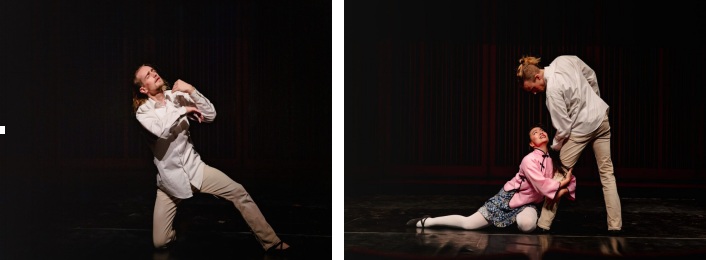
Left: A broken Caleb longs for the violin.
Right: Rose clings to her love.
This excerpt was based on a true story, where over 20,000 Jewish refugees found safety in Shanghai during the Holocaust. Following the Japanese occupation of China, many of these refugees were tortured as well. Malcom plays Caleb, a Jewish violinist seeking refuge in China. After his fingers are crushed by the Japanese, Malcolm loses all hope, as he could no longer play the violin, the one thing that brought him joy in a wretched existence. When he is about to take his own life, Rose stops him, bringing hope and love into the previous void. Their story shows that love can overcome all things. But even more than just love, their story displays the prevalence of human kindness, affection, and a sense of hope for life.
“It’s about life, love, and hope,” Starry Wu told me.
Shanghailanger ends with “Meigui Meigui wo ai ni,” a Mandarin song popular among Jewish Shanghai refugees. The popular song lit America ablaze after being recorded in English by Frankie Lane and Petula Clark (PBS SoCal).
The excerpt poignantly captures that although war threatens to extinguish everything, hope remains. In the ashes, these embers continue to flicker, eventually coming back to life and displaying that humanity continues despite devastation.
However, this excerpt was the finale to a long showcase of riveting performances. The show began with the Minnesota Huayue Music Ensemble, including the dizi, yangqin, guzheng, the cello, erhu, and cymbals. The fusion of East and West showcases Modern China’s malleability to include Western techniques and instruments while proudly maintaining the Chinese core. The players ranged in age, with two high schoolers who played the erhu and guzheng. The presence of young blood displays how there was a presence of revival in a dying tradition.
In addition, master guzheng player 李家骧 LinJia Xiang displayed his skill by depicting a general’s longing for home. The Three Performances of Plum Blossom《梅花三弄》“is a work from the 1990s that celebrates the spirit of plum blossoms.” The vivid imagery of plum blossoms is significant to Chinese identity as “they symbolize strength and flourish even more vigorously in colder climates.” Sitting under a plum tree, Xiang depicts a man wrought with competing emotions towards duty, hope, and contemplation. Nonetheless, at the end, the general remains resolute, unwavering, yet aching with homesickness.
Their performances aptly show how music can be a portal towards the soul. And despite less interest in playing Chinese instruments in the East (in comparison with the piano or violin), the longevity of diversity of Chinese culture is rooted in the eternal component of music.
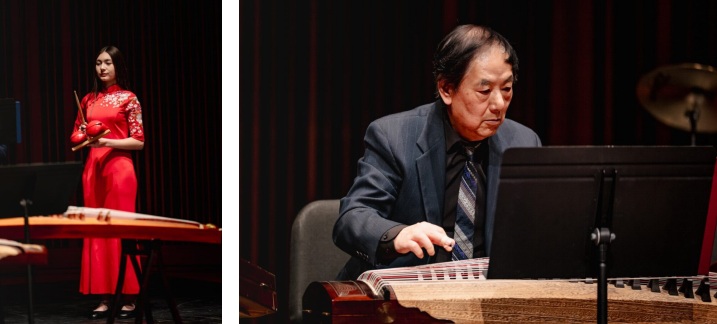
Left: One of the highschoolers, who plays the percussion and erhu.
Right: Master guzheng player 李家骧 LinJia Xiang.
Powerful dances rooted in Chinese history and folklore continued the production, including an elegantly powerful “Great Wall Dance,” where conscripted peasants depicted the sacrifice and fear present in defending China’s border against invaders. Passion for their nation was mixed with longing as these actors masterfully spun around with swords. (Dancers: Ming Li, Maria Hom, HunWen Westman, Elena Lan Youngdale, Alex Lai, Malcolm Peterson).
In another act, Ling Wang/Clara Wong play a woman whose life is destroyed when her lover leaves to defend the border. With the death sentence leaves a “summer of parting,” where her only companion is a flickering candle. Wearing a flowing pink qipao and donning a fan, Wang depicts a wife’s hopeful anticipation as she continues to wait for her love.
Another act highlights the legend of Mulan, whose love of her father and devotion to her country led her to take her father’s place in the army and conceal her identity. She is overjoyed to finally return home. Played by Seeley Schafer and Serena Watson, the dancer is clad in a soldier’s attire, surrounded by the Mongolian steppes and wearing a colorful outfit and headdress. I was pleasantly surprised to see her depicted as masculine and strong, explaining how a woman survived years of war.
The tragedy of Yang Guifei, the most beautiful woman in Chinese history, was played by Ling and Ju-Chang Wang, depicting the unjust nature of her forced suicide. Wearing a stunning red Hang Tang garment from the Tang Dynasty and spotting a regal headdress, the dancer showcased how duty and devotion towards one’s country surpasses all. In this depiction, Guifei faces the uncertainty of death with elegance, dancing with death and unwavering to the end.
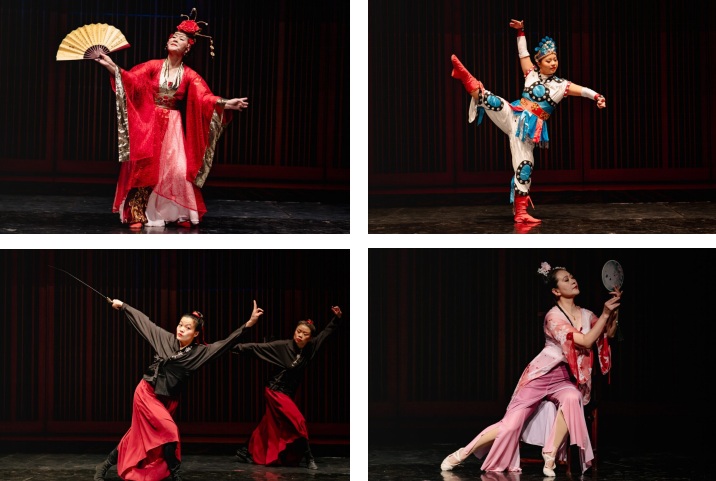
Upper Left: Yang Guifei’s final dance (Played by Ling Wang/Ju-Chang Wang).
Upper Right: Mulan dances with power and elegance (Performed by Seeley Schaefer/Serena Watson).
Bottom Left: An impatient wife (Performed by Ling Wang/Clara Wong).
Bottom Right: Soldiers defending the border (Performed by Ming Li, Maria Hom, HunWen Westman, Elena Lan Youngdale, Alex Lai, and Malcom Peterson)
The audience was captivated by the dances. The next piece showcased the legacy of Mu Guiying, the daughter of a general who stood up to lead an army during a period of national crisis. In a society historically rooted in patriarchy, these legends of courageous women provide inspiration for young girls seeking role models apart from the stereotypical “helpless heroine” trope. According to the program, “during the War of Resistance against Japanese invasion (1937-1945), it [this heroic song] embodied a phoenix-like spirit.” Through a Beijing Opera, invited artist Ling Wang artistically depicted a woman’s feminine side with the necessity of sharp masculinity for survival during war.
Immediately following was a bow dance taking place after the Opium Wars and the Sino-Japanese War, after China’s “Century of Humiliation” from foreign powers. Native resistance from the countryside was spurred from “shared indignation.” The bow dance act depicted farmers from every pocket of the nation coming forward to defend their nation.
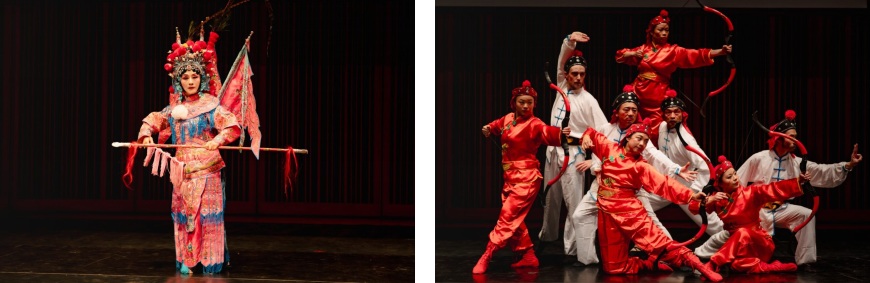
Above: Ling Wang’s Mu Guiying
Right: The fierce bow dancers (Joseph Lin, Malcom Peterson, Alex Lai, Owen Wen, HunWen Westman, Marian Hom, Serena Watson, Seeley Schaefer).
The acts were both received by enthusiastic applause.
Immediately following was a somber performance by the Minnesota Huayue Music Ensemble reflecting the “fiery years” where 35 million Chinese lost their lives during the Second World War.
In the silence came my favorite act by far – a performance that ties past to history, showing the heartbreaking reality of familial love and sacrifice. In a duet by Lan Youngdale and Claire Chamberlain, two sisters dying from dehydration are faced with a stark dilemma: there remains one flask of water, enough to save one of them.
With an orchestral backdrop led by a melancholic cello melody, the elder and younger sister fight over the water, each unwilling to drink and begging the other to live. They dance together, synchronized movements dripping with sacrifice, grit, love, and plain heartbreak.
At the end, as the younger sister lies motionless, the older sister hesitates. She prepares to drink, guilt hardening into unwavering resolve. She pours the water into her younger sister’s parched throat, then passes away in the unforgiving conditions.
When the younger sister awakens, she attempts to pour the flask into her dead sister’s throat, before realizing that the flask is empty: her sister had sacrificed herself.
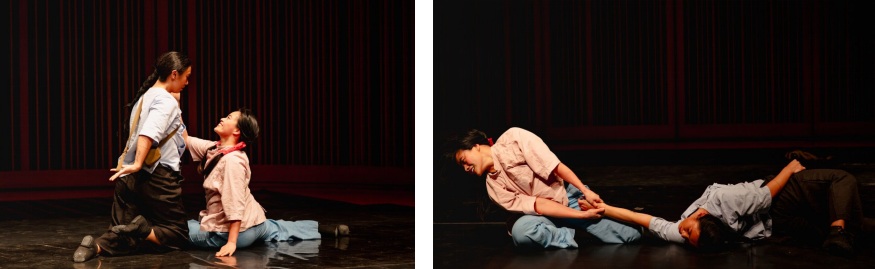
Above and Right: Sisterly love (played by Elena Lan Youngdale and Claire Chamberlain).
The last act unmentioned was a soprano solo by the founder Starry Wu herself. Adorned in a stunning purple dress, Starry soulfully sang To Rebuild Our Nation Depends on the Young, a “lament and cry of a people in peril.” Despite the agony, there is an “unyielding spirit of a nation destroyed and families lost.” Aptly described:
“A silent stream of blood in my heart, a mother’s loving care … restoring our land to a future life…”
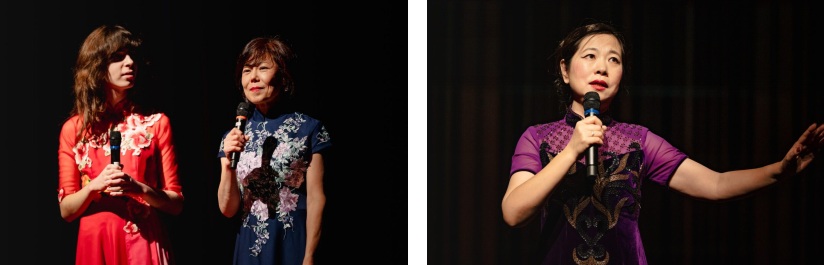
Above Left: Emcees Elina Poll (left) and Floria Liu (right)
Above Right: Starry Wu dazzles in her solo.
“The future of our society,” the emcees stated, “depends on our young.”
I think that is fittingly stated. The younger generation is increasingly turning away from traditions that have lasted for thousands of years. Chinese dance, martial arts, traditional watercolor, calligraphy, classical folk instruments, and Beijing Opera are all rapidly disappearing. Instead, youth increasingly seek to Westernize, with traditional artistry quickly replaced by piano, violin, and Western dance styles.
When I visit cultural festivals, the performing faces are almost entirely aged, with very few young attendees or performers. Thus, “From Ashes to Roses” was a complete surprise: Not only were there a plethora of young dancers and musicians, many of these participants were Chinese adoptees of Western parents, who found dancing as an integral way to maintain their Chinese heritage and regain cultural identity despite loss. This will be a theme I will cover in future articles.
Just as the production demonstrates the incredible resilience and beauty of the Chinese people, “From Ashes to Roses” provides a glimpse to the next generation of young dancers and musicians, a spark emerging from the ashes and shining bright for the entire world to see.
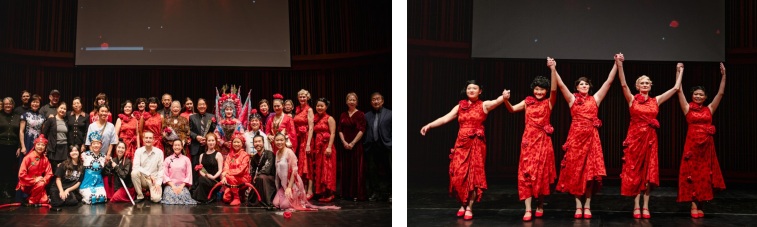
Above Right: Beautiful group picture.
Above Left: A touching picture of mothers and daughters.
Recommended Resources:
Event: From Ashes to Roses 灰烬·玫瑰 Tickets, Sat, Dec 13, 2025 at 7:30 PM | Eventbrite
Shen Pei Performing Arts Alliance: Performing Arts: About 关于我们 – home
Minnesota Huayue Music Ensemble (明州华乐): Our Musicians – Minnesota Huayue Music Ensemble
Life of Shen Pei: 2006 Chinese Minnesotan of Note – Shen Pei – Chinese Heritage Foundation
Shanghailander Lead Dancer Bios
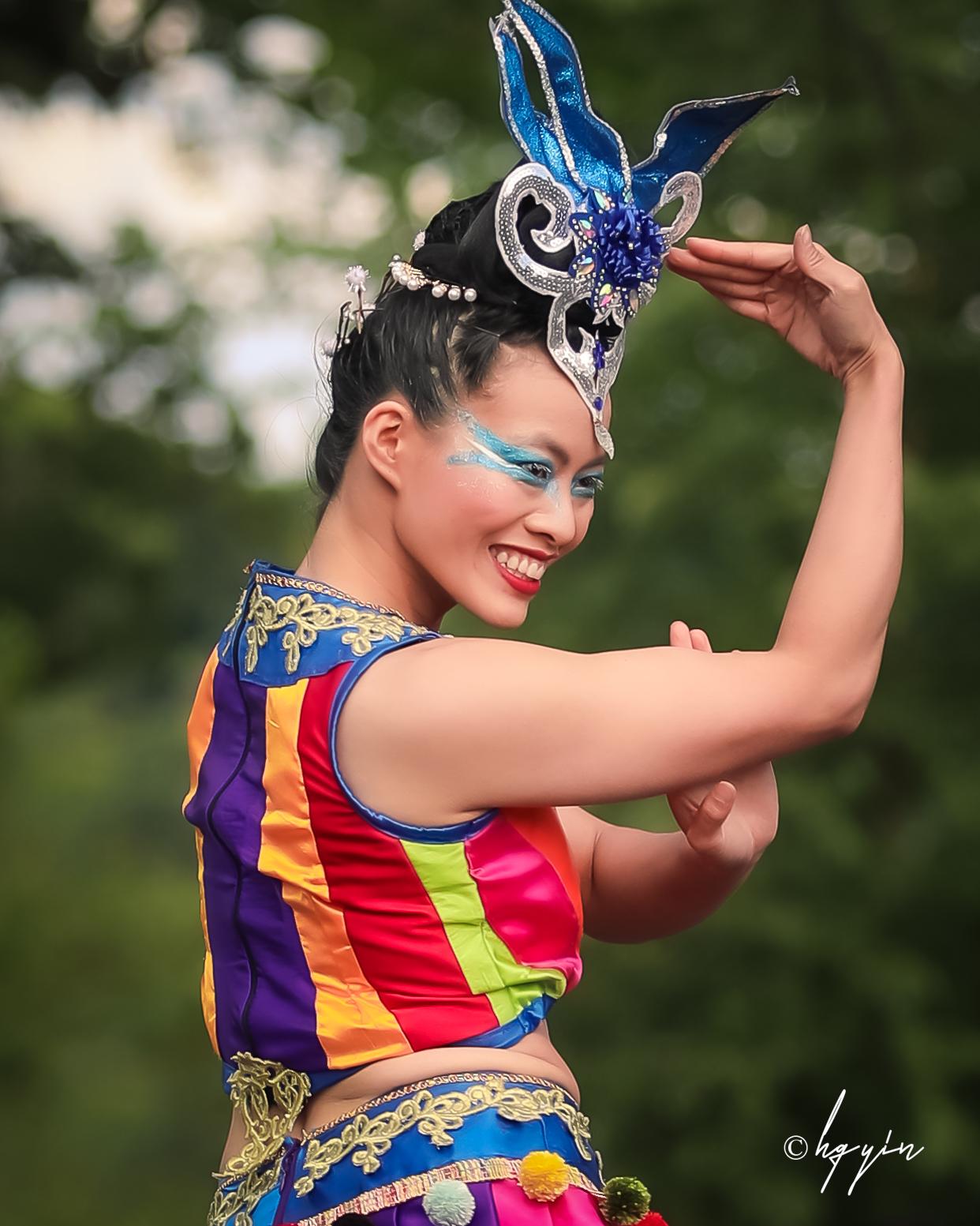 |
Elena/Lan Youngdale (Jin Lan金兰): Lan joined CAAM Chinese Dance Theater when she was four years old. She grew up dancing; learning and performing classical and folk styles of various ethnic groups around China. As she entered college, Lan studied biomechanical physics, culture and history in China, and various movement styles inside and outside of ‘dance’ specifically. Movement is integral to Lan’s self-expression and central in a majority of her communities. |
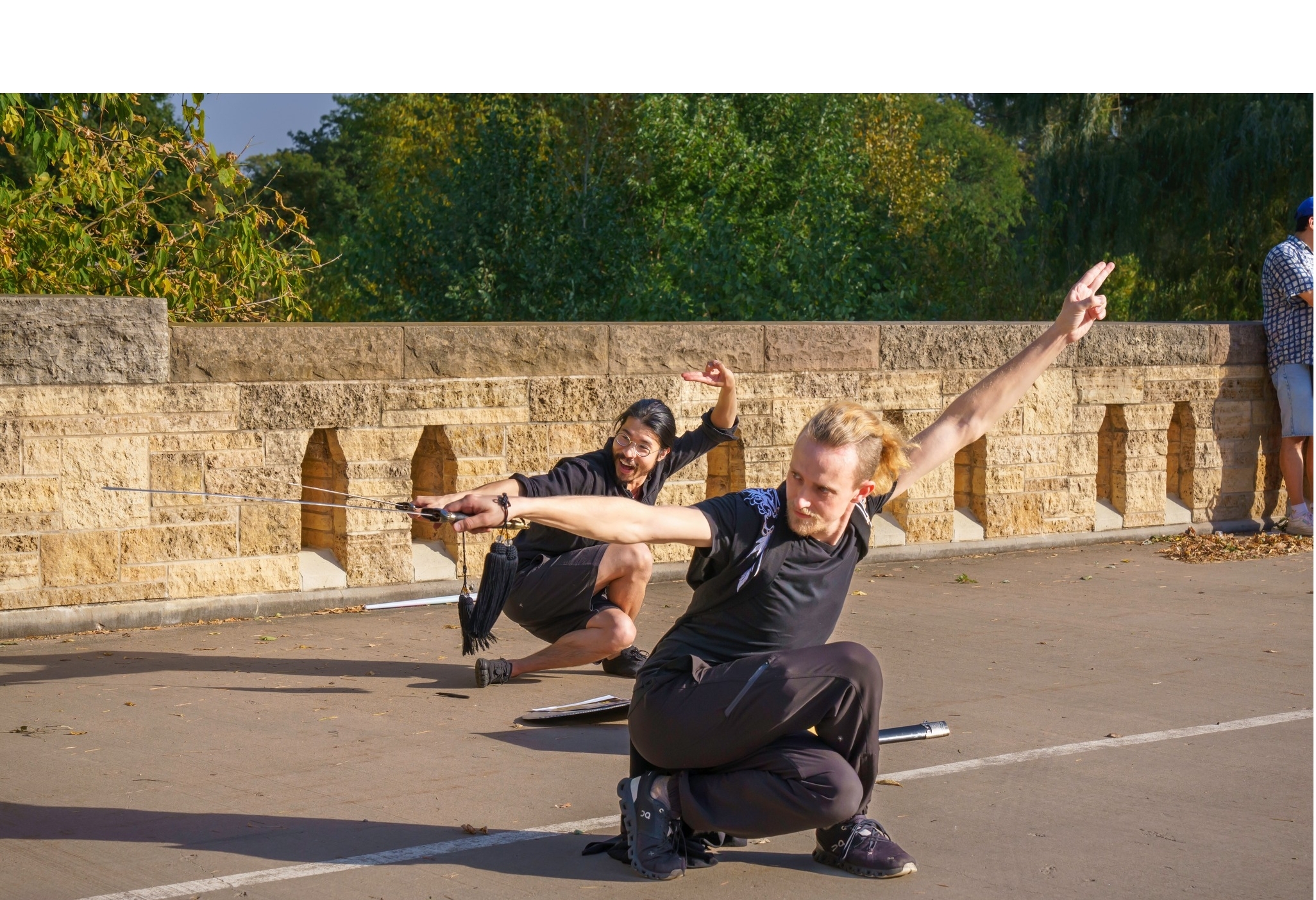 |
Malcom Peterson: In addition to majoring in dance at the U of M, Malcolm has studied Chinese dance for over 17 years. Much of that time was with Shen Pei, learning how to tell stories through dance. He is fascinated by the way dance seeks the center of human experience. |