
By Jenny Liang, CI Staff Writer
The number three holds sacred meaning in many contexts. In Buddhism, the three higher trainings of ethics, meditation, and wisdom lead to spiritual awakening. There are three Abrahamic faiths, and in Christianity, God is viewed through a trinitarian lens. In the realm of architecture, the three-sided triangle is held to be the strongest shape. Many authors choose to structure their story arcs through triologies. And in the athletics domain, the triathlon discipline tests endurance through swimming, cycling, and running. This philosophy is no different in the creative arts, where “The Three Perfections” of visual artistry manifests in mastering the expressions of poetry, calligraphy, and painting.
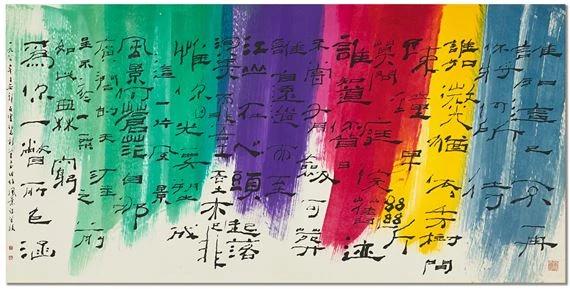
“Splashed-Colour Calligraphy,” by Pat Suet-Bik Hui and Wucius Wong, 1987, ink and watercolor on paper. Auctioned by Christie’s and purchased by a private buyer in 2020.
For decades, Pat Suet-Bik Hui has stood at the peak of Chinese ink painting. Alisan Fine Arts praises the Hong Kong artist for “her colorful paintings” (Alisan Fine Arts, Hui, Pat, Hui, Pat | Artists | Alisan Fine Arts 藝倡畫廊). Since primary school, Hui has been passionate about poetry, calligraphy, and painting. In high school, she was mentored by Lui Shou-Kwan, one of the most prominent ink painters of the generation: Shou-Kwan pioneered the New Ink Training Movement to “modernize traditional Chinese ink painting in Hong Kong” (“Ink Play: Paintings by Lui Shou-Kwan, Art Institute of Chicago, Ink Play: Paintings by Lui Shou-Kwan | The Art Institute of Chicago). Since the 1980s, Hui has collaborated on hundreds of paintings with the renowned Wucius Wong, and her works have been displayed in global collections and galleries (Wucius Wong and Pat Hui, The Poetic Visions, Hong Kong: Alisan Fine Arts, 2005).
Wong, likewise, is a Hong Kong calligrapher and ink painter. His paintings have been exhibited globally, including at London’s Goedhuis Contemporary, Hong Kong’s Grotto Fine Arts, Minnesota’s own Minneapolis Institute of Arts, Finland’s Amoso Anderson Museum, Bahrain’s First Exhibition of Asian Art, Brazil’s Sao Paulo Biennale. Most notably, his “Mountains and Clouds No. III” was displayed in and auctioned by the renowned Sotheby’s.
Wucius Wong applauds his contemporary, writing “her colours are sometimes in quiet pastel shades, but generally tend to exhibit a strong radiant quality, evoking a sense of pathos often expressed in Song poems with themes of solitude, remorsefulness, and desolation, employing images of distinctive colour sensations such as falling petals, willows, autumn leaves, the setting sun, the moon.”(Wucius Wong, Pat Hui, Alisan Fine Arts, Hong Kong, 1993, .P.6)
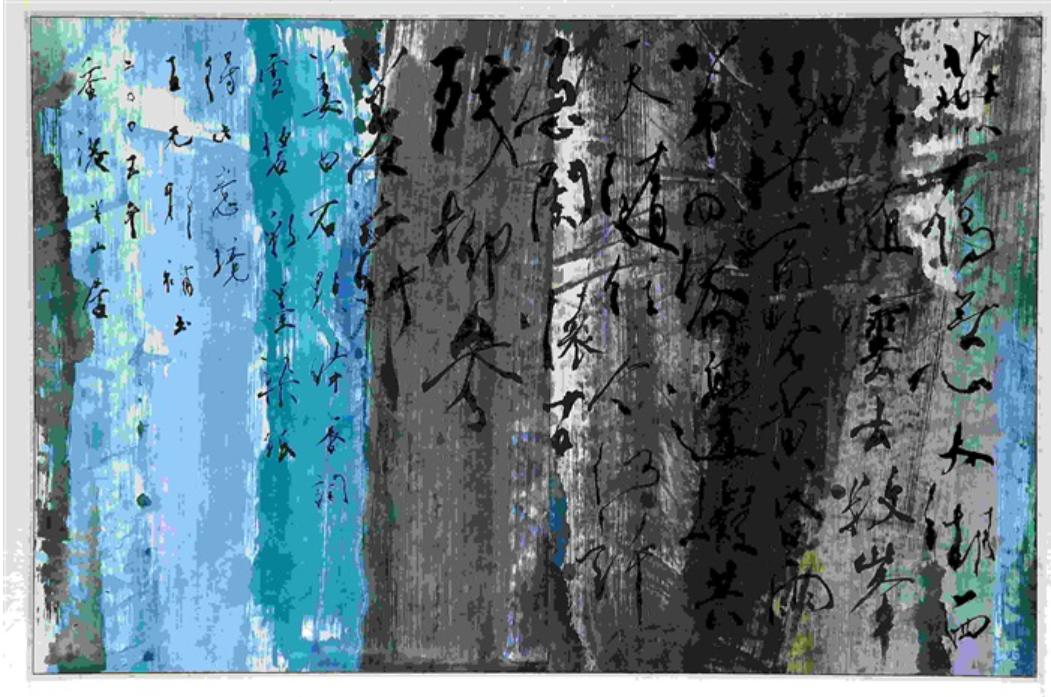
“Collaborative Work with Wucius Wang-The Yan Geese are Heartless” by Pat Suet-Bik Hui and Wucius Wong, 2005, ink and watercolor on paper. Exhibited by Alisan Fine Arts.
However, Pat Hui wielded a pen, not a brush, at the start of her career. Ms. Suet-Bik Hui herself wrote, “at that time, I was more interested in literature than art” (Pat Hui, The Poetic Visions, Hong Kong: Alisan Fine Arts, 2005, pg. 7). The Hong Konger specialized in philosophy, first at the University of Hong Kong, then as a Ph.D. candidate in Western philosophy at the University of Minnesota. In addition to philosophy, Hui studied Chinese and Indian Buddhism.
In Pat Suet-Bik Hui’s journey to discover philosophical truths and the nature of perception, she fell in love and became swept away by the universal and eternal beauty of Chinese poetry and watercolor. “The Three Perfections,” according to Pat, holds long lasting meaning that transcends time and artificial boundaries. Born and raised in Hong Kong, a former British colony that now faces sinicization, Hui was no stranger to the political and cultural tensions between East and West. In a way, it makes Suet-Bik Hui the perfect narrator for the modern Chinese artistic voice. During her journey to convert millenia of Chinese poetry into visual masterpieces, Pat Hui has become a bridge between Eastern philosophy and Western artistic abstractism.
After Pat brushes layers of vivid, stained ink onto large sheets of parchment and selects a corresponding poem that captures the essence of the piece, Wucius expertly writes the calligraphy. For “The Yan Geese are Heartless” (2005), the blue-and-gray ink and colour on paper pictured above, Pat Hui translated the Mandarin poem written by Zhang Baishi for her English-speaking audience:
The Yan Geese are heartless
Following the clouds to the west side of Lake Tai
A few scattered peaks
A shower of dusk rain
By the Forth Bridge
Want to go with the sky
What about now
Thinking of the past by the rail
The withered willows seem to be dancing
Today, Pat Suet-Bik Hui’s life and legacy revolves around “The Three Perfections,” curating poetry, calligraphy, and painting into a “visual feast invoking a humanistic and positive outlook on life” (Alice King in The Poetic Visions, Hong Kong: Alisan Fine Arts, 2005, pg. 3). As her art pieces dance between continental galleries and exhibits, the artist has settled in L’Étoile du Nord. Hui started a celebrated art gallery and studio in Minneapolis before she reallocated her focus to creating exhibitions, freelance painting, writing poetry, and serving as a translator.
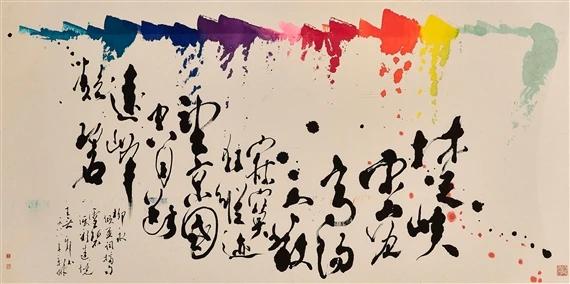
“Splashed-colour Calligraphy: Poem by Liu Yong,” by Pat Suet-Bik Hui, 1988, watercolor on paper. Sold 2018.
During the Italian Renaissance, arguably one of the great peaks of Western civilization, the concept of the “Universal Man” emerged amongst the intelligentsia. Rooted from humanism and its elevation of human reason and intellect, well-respected members of Italian nobility began to focus on becoming well-rounded masters of multiple disciplines, including architecture, sculpting, artistry, engineering, writing, philosophy, medicine, music performance and composition, astronomy, politics, physical combat, theology, and science. Masters of these universal traits include the ranks of Leonardo da Vinci, Galileo Galilee, Michelangelo, Benjamin Franklin, Aristotle, and Albert Einstein.
With her background in Western philosophy, Pat Suet-Bik Hui has incorporated the universal languages of poetry, painting, and calligraphy for a global audience. In 2024, The College of Liberal Arts at the University of Minnesota, Ms. Hui’s alma mater, held an exhibition for her works, titled Poetic Visions, at Johnston Hall. And even today, as Pat mixes Abstract Expressionism and Western modern art with Chinese ink and calligraphy, her love of philosophy shines through each deliberate stroke, calibrated to represent the quintessence of each poem and the spirit of each character.
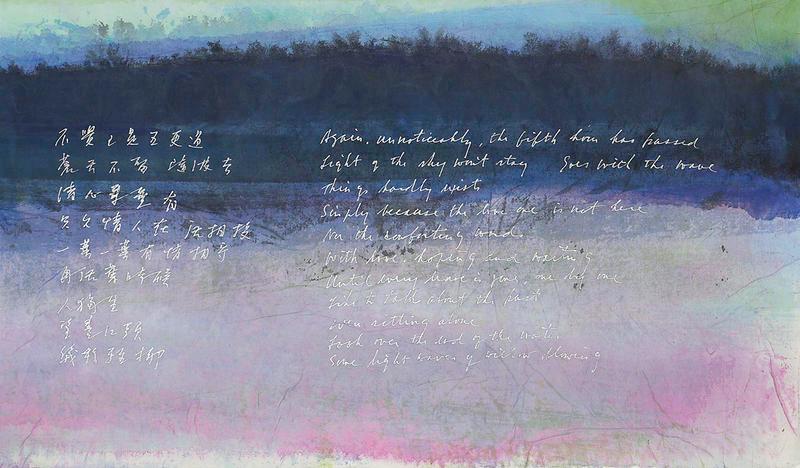
“Painting with Poem,” by Paul Ka-Yin Kwok and Pat Suet-Bik Hui, 1999, ink color on paper. Displayed at Ashmolean Museum.
Just like food and music, visual artistry is considered a universal language capable of transcending cultural and linguistic boundaries. Although viewers may not understand the Chinese characters, the artistry and eye-catching beauty of Hui’s paintings are unmistakable.
And, despite over four decades of contribution, Pat Suet-Bik Hui continues to bridge the Eastern and Western Diaspora through her newest exhibition at the University of Oxford’s Ashmolean Museum. The displayed works, which Ms. Hui gifted to historian Michael Sullivan, “fuses abstract and semi-abstract washes of colour and ink with simple, restrained calligraphy inscribing poems reflecting on a variety of themes, from love, to loss, to the pleasures of drinking” (Ashmolean Museum, PAT SUET-BIK HUI & THE THREE PERFECTIONS: POETRY, CALLIGRAPHY, PAINTING, PAT SUET-BIK HUI & THE THREE PERFECTIONS | Ashmolean Museum).
In a modern global landscape steeped in political and social instability, art brings color to a bleached scenery of pessimism and fear. The lifeblood of art pieces convey yearning for a more hopeful future, where the viewer can be contentfully lost in the perfection of the moment. And as art continues to evolve alongside society, Pat Suet-Bik Hui continues to paint the color of words.
____________
Pat Suet-Bik Hui’s Ashmolean Gallery Exhibition: The Three Perfections
This is a gallery exhibition from September 20, 2025 until June 28, 2026. For community accessibility, admission is free to viewers.
China Insight’s Article on Poetic Visions: Poetic Visions by Pat Suet-Bik Hui
Follow Pat Hui’s current endeavors on Facebook: Pat Hui: Facebook.
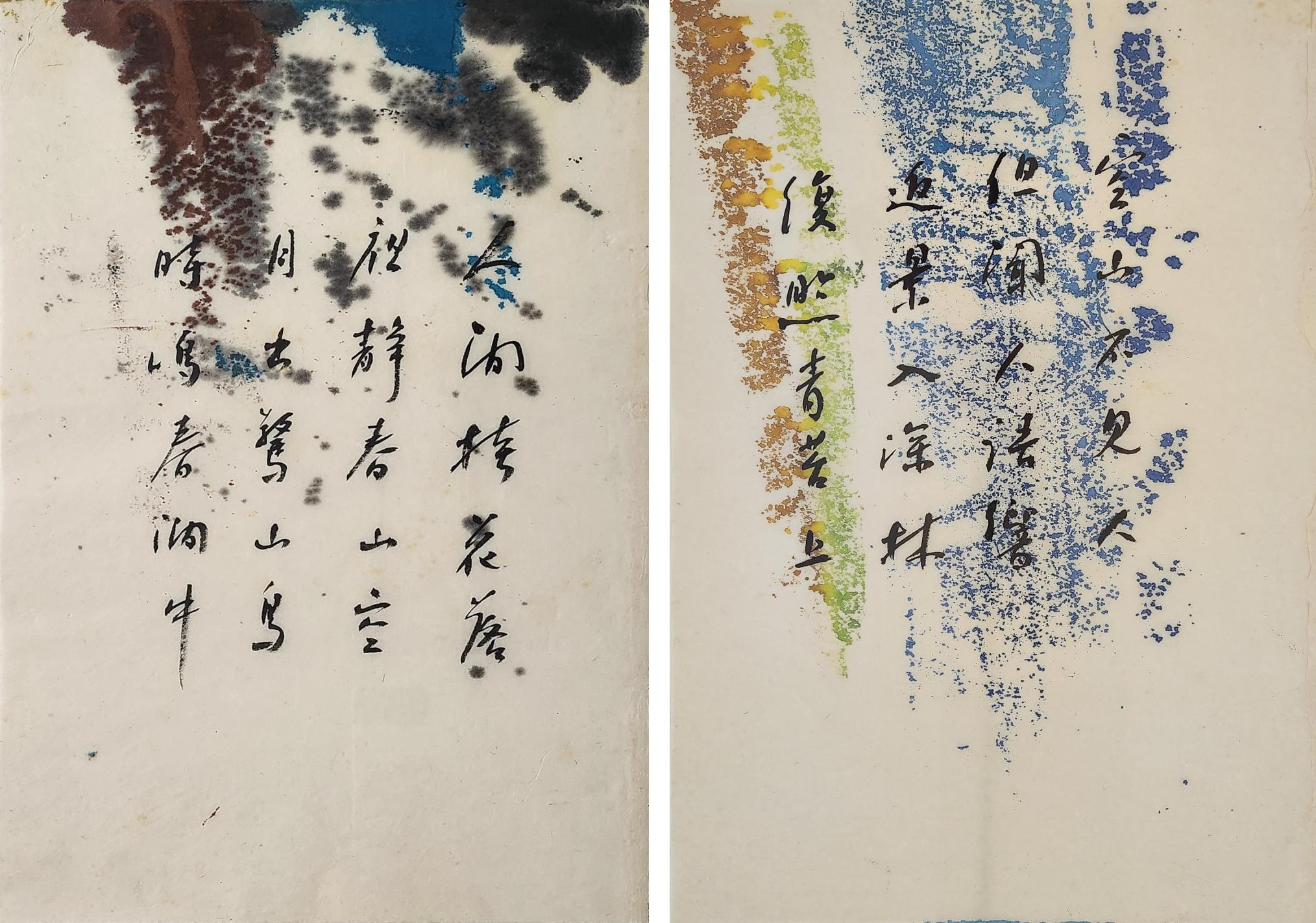
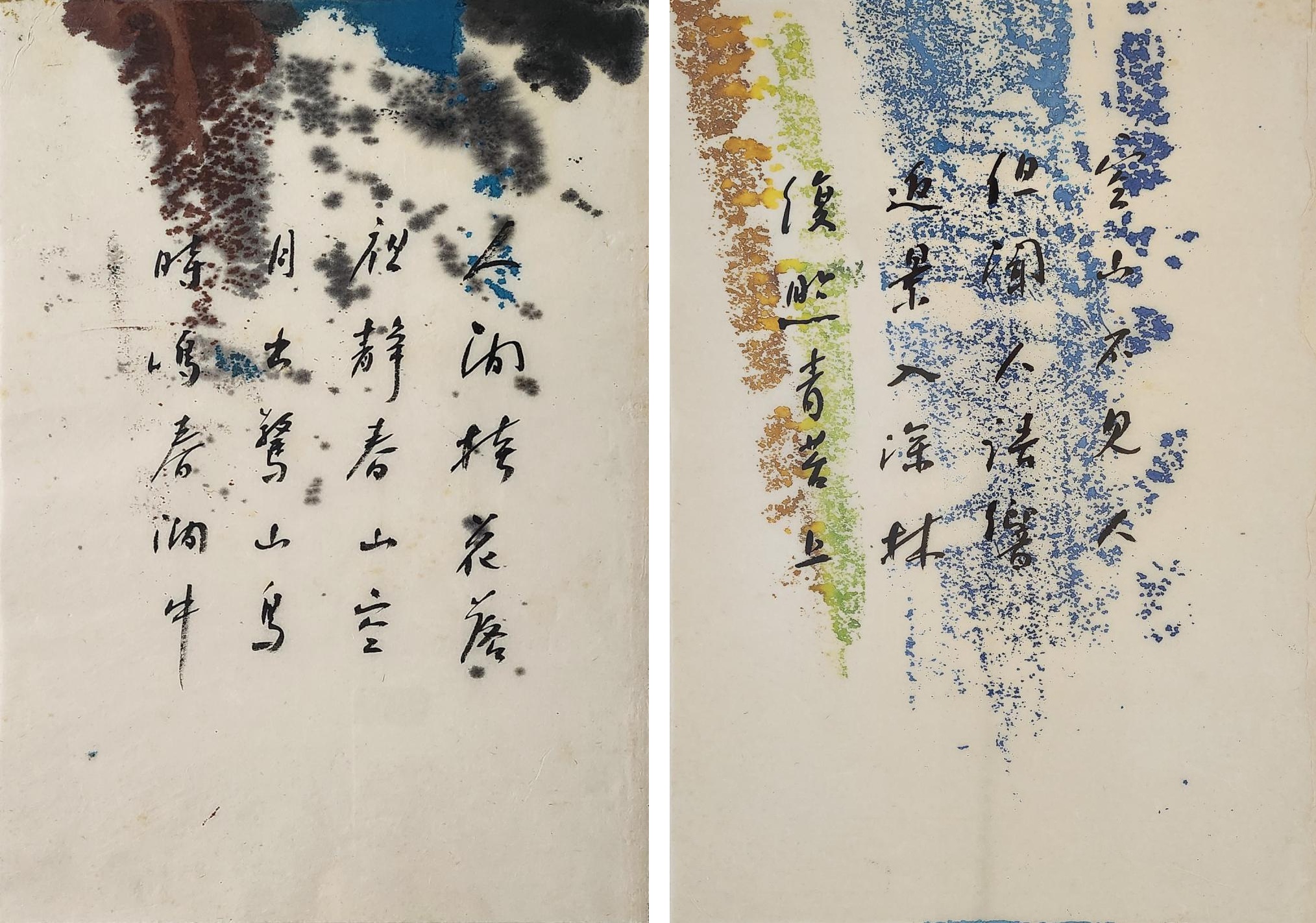
Left: “Man at Leisure, Cassia Flowers Fall,” by Pat Suet-Bik Hui, 1993, ink and watercolor on paper. Exhibited by Alisan Fine Arts.
Right: “Empty Mountain, No Man is Seen,” by Pat Suet-Bik Hui, 1993, ink and watercolor on paper. Exhibited by Alisan Fine Arts.