
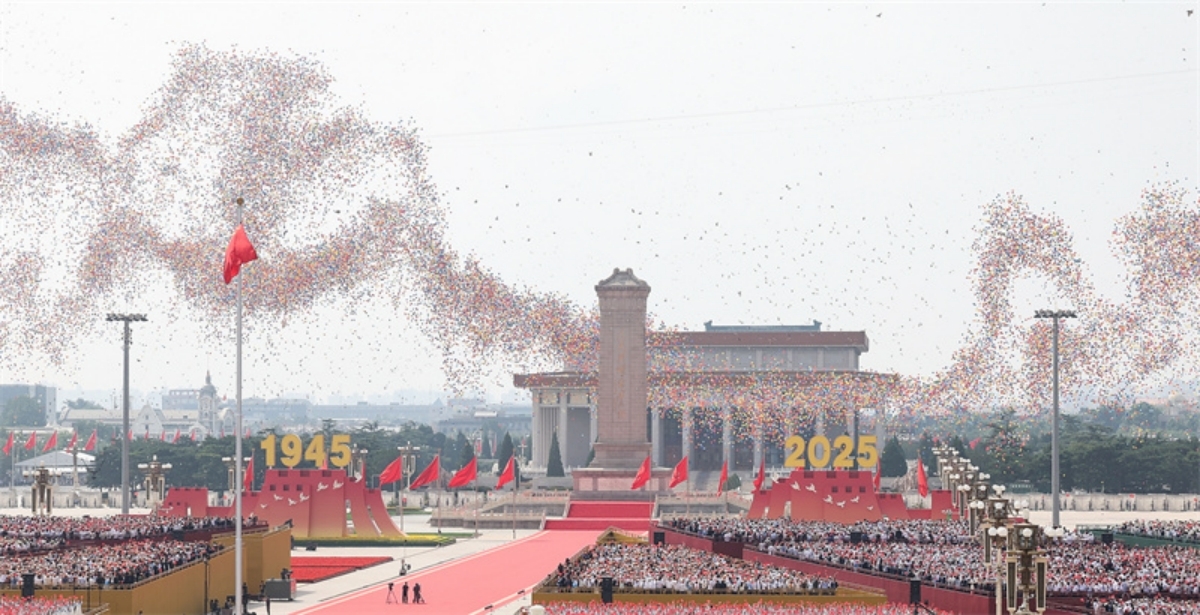
Balloons and pigeons are released into the sky over Tian’anmen Square in Beijing, capital of China, Sept. 3, 2025. China on Wednesday held a grand gathering to commemorate the 80th anniversary of the victory in the Chinese People’s War of Resistance against Japanese Aggression and the World Anti-Fascist War. [Photo/Xinhua]
1. Full Nuclear Triad on Display
China unveiled for the first time a complete strategic nuclear triad—land-, air-, and sea-based nuclear delivery systems. This included:
-
- New intercontinental ballistic missiles (ICBMs) like the DF-61 and DF-31BJ (both mobile), and the silo-launched DF-5C capable of carrying multiple warheads and reaching global targets AP Newseuronewsiz.ruFirstpostHouston Chronicle.
- Air-launched (JL-1) and submarine-launched (JL-3) ballistic missiles AP NewsCBS Newsiz.rueuronews.
2. Hypersonic and Anti-Ship Missiles
Several advanced anti-ship missiles such as the YJ-15, YJ-17, YJ-19, and YJ-20 (hypersonic-capable) were paraded, signaling coastal and regional power-projection capabilities AP NewsDaily SabahPBSeuronews.
3. Advanced Drone and Underwater Systems
China showcased a range of unmanned systems across domains:
-
- Large underwater drones (e.g., AJX002 and HSU100) for reconnaissance or mine-laying operations AP NewsDaily SabahPBSeuronewsHouston Chronicle.
- Stealth and AI-assisted aerial drones, including “loyal wingman” UCAVs like the GJ-11 CBS NewsThinkChinaPBS.
- Ground robots—sometimes referred to as “robot wolves”—capable of tasks such as reconnaissance or mine detection CBS NewsForeign Policy.
4. Directed-Energy (Laser) Weapons
The LY-1 high-energy laser weapon was revealed, potentially capable of disabling electronics or aircraft, bolstering China’s air-defense and electronic warfare toolbox Daily SabahCBS NewsWikipedia.
5. Layered Air and Missile Defense & Networked Warfare
Systems like the HQ-16C, HQ-10A, and the high-altitude HQ-29 (capable of targeting satellites) were presented, along with electronic warfare and communications systems—emphasizing domain control and battlefield coordination AP NewsPBSeuronewsDefense NewsYoung Pioneer Tours.
6. Indigenous Innovation & Modernization
All displayed weaponry was domestically developed, signaling a departure from earlier reliance on foreign technology and reflecting China’s deepening technological self-sufficiency Defense NewsHouston ChroniclePBS.
7. Geopolitical Messaging
The parade wasn’t just about hardware—it was a powerful geopolitical signal:
-
- It underscored China’s growing military prowess and political confidence, positioning itself as a challenger to the U.S.-led international order The Guardian+1Financial TimesReutersAP NewsWIREDForeign Policy.
- The attendance of leaders such as Putin and Kim Jong-un reinforced emerging alliances and an anti-Western bloc The Guardian+1Financial TimesForeign PolicyWikipedia.
- Xi Jinping’s remarks—“peace or war,” “unstoppable rejuvenation,” and references to Taiwan—mixed symbolism with strategic deterrence The GuardianFinancial TimesForeign Policy.
In Summary
The Chinese military parade was more than a ceremonial display—it was a full-spectrum showcase of breakthrough weapon systems (nuclear, hypersonic, drone, laser, cyber/space defense) and reflected a clear strategic posture: technological maturity, sovereign military strength, and global ambition. It sent a message domestically of national pride and modernization, and internationally of emerging deterrence and realignment in global power balances.